

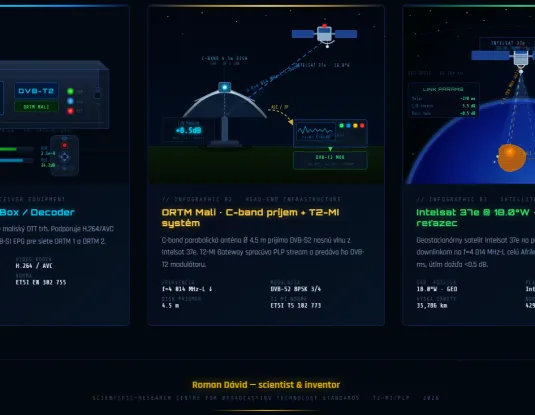
ORTM MALI: DVB-T2/T2-MI - INFOGRAPHIC GALLERY
Vyberte si konkrétne v ktorom jazyku si chcete prečítať novinku : ENG,DE,FR,RU,SK
Выберите, на каком языке вы хотите прочитать новость:ENG,DE,FR,RU,SK
Select the specific language in which you would like to read the news: ENG,DE,FR,RU,SK
Wählen Sie die konkrete Sprache, in der Sie die Neuigkeit lesen möchten :ENG,DE,FR,RU,SK
SK>
EN>
DE>
FR>
ES>
RU>
ABSTRAKT
Táto štúdia predstavuje komplexnú technickú a socio-infraštruktúrnu analýzu satelitného vysielacieho systému ORTM (Office de Radiodiffusion-Télévision du Mali), so špecifickým zameraním na architektúru T2-MI (DVB-T2 Modulator Interface) a PLP (Physical Layer Pipe) využívanú na distribúciu signálu prostredníctvom geostacionárnej satelitnej stanice Intelsat 37ena orbitálnej pozícii 18,0° Západ. Signál ORTM je distribuovaný v C-pásme na downlinkovej
frekvencii 4 014 MHz (Ľavotočivá polarizácia, C-pásmo: presne 1 136 MHz MHz po konverzii v LO-LNB). Štúdia skúma technické dôvody pre adopciu DVB-T2 ako národného štandardu digitálneho pozemného televízneho vysielania (DTT) v Mali, úlohu satelitom dodávaných T2-MI prúdov pri umožňovaní architektúr SFN (Single-Frequency Network) a MFN (Multi-Frequency Network), regulačné a ekonomické aspekty nasadenia dekodérov a širší kontext digitálneho vysielania v
Západnej Afrike. Analýza je zakotvená v príslušných normách ETSI/DVB a krížovo overená s potvrdenými prevádzkovými dátami zo satelitných monitorovacích zdrojov a primárnej odbornej literatúry.
Kľúčové slová:
DVB-T2, T2-MI, fyzická vrstva rúra (PLP), Intelsat 37e, C-pásmo satelitné vysielanie, ORTM Mali,digitálne pozemné televízia, SFN, Afrika DTT, ETSI EN 302 755, ETSI TS 102 773
1. ÚVOD A KONTEXTOVÝ RÁMEC
1.1 Republika Mali: geografia, infraštruktúra a výzvy vysielania
Republika Mali je vnútrozemský štát v Západnej Afrike s rozlohou 1 241 238 km², čo z nej robí ôsmu najväčšiu krajinu afrického kontinentu. S odhadovaným počtom obyvateľov cca 22,4 milióna (Svetová banka, 2024) predstavuje Mali náročné operačné prostredie pre plánovačov národného vysielania. Aproximatívne 65 % územia krajiny je klasifikovaných ako aridné alebo semiaridné saharské/sahelské územie a obyvateľstvo je rozptýlené v ôsmich administratívnych regiónoch a hlavnom meste Bamako, s významnou vidieckou rozptýlenosťou a nízkou hustotou obyvateľstva v severných oblastiach ako Kidal, Gao a Timbuktu. Národná elektrická sieť je nespoľahlivá a pokrýva len približne 30 % územia, primárne v mestských centrách. Cestná infraštruktúra zostáva nedostatočná na podporu údržby veľkého počtu pozemných vysielacích staníc vo vzdialených oblastiach. Tieto štrukturálne obmedzenia robia satelitom podloženú
distribúciu signálu operačne a ekonomicky nadradeným riešením pre napájanie národnej siete vysielačov digitálneho pozemného televízneho vysielania (DTT), čo opodstatňuje nasadenie architektúry distribúcie T2-MI/PLP skúmanej v tejto štúdii
1.2 Historický vývoj ORTM
Vysielanie v Mali predchádza národnej nezávislosti. Radio Soudan, vysielač 1 kW AM prevádzkovaný z Bamaka, začal vysielať v roku 1957 pod francúzskou koloniálnou správou Francúzskeho Sudánu. Po dosiahnutí nezávislosti 22. septembra 1960 bol premenovaný na Rádio Nationale du Mali a rozšírený za pomoci z ČSSR dodávaných vysielačov (18–30 kW, 1962) a štyroch 50-kW čínskych vysielačov umiestnených cca 7 km od Bamaka v smere na Kati (uvedených do prevádzky v roku 1970). Televízne vysielanie bolo zavedené 22. septembra 1983 otvorením libyjsky financovaného vysielacieho centra v Bamaku. Zákon č. 92-021 z 5. októbra 1992 liberalizoval mediálny sektor a reštrukturalizoval RTM na ORTM (Office de Radiodiffusion-Télévision du Mali) s účinnosťou od 1. januára 1993. Ďalšia reorganizácia bola vykonaná v roku 2015 prostredníctvom Nariadenia č. 2015-036/PRM. ORTM prevádzkuje dva televízne kanály (ORTM 1 a ORTM 2), dve národné rádiové siete a koordinuje činnosť regionálnych vysielacích bodov. Rozpočet ORTM na rok 2024 bol stanovený na 12,8 miliardy XOF (cca 22 miliónov USD), z čoho 62 % pochádza zo štátneho rozpočtu.
1.3 Sledovanosť a dosah publika ORTM
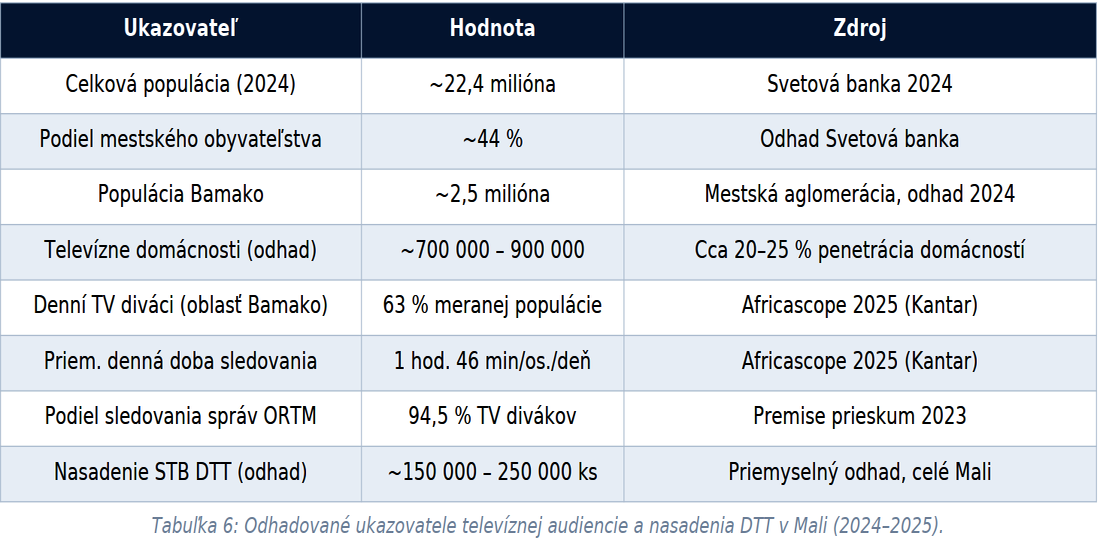
Podľa prieskumu Premise (2023) je ORTM jednoznačne dominantným zdrojom televíznych správ pre malijské publikum: 94,5 % respondentov uviedlo ORTM ako svoj primárny zdroj televíznych správ, ďaleko pred komerčnými konkurentmi Renouveau Télévision (68,9 %), TM2 (51,2 %) a Africable (46,7 %). Štúdia Africascope 2025 (Kantar) uvádza, že Mali zaznamenáva najnižšiu dennú kumulatívnu televíznu audienciu spomedzi ôsmich skúmaných afrických trhov — 63 % me-ranej populácie s priemernou dobou sledovania 1 hodina a 46 minút na osobu denne.
2. SATELITNÁ PLATFORMA INTELSAT 37E
2.1 Špecifikácie satelitu a orbitálne parametre
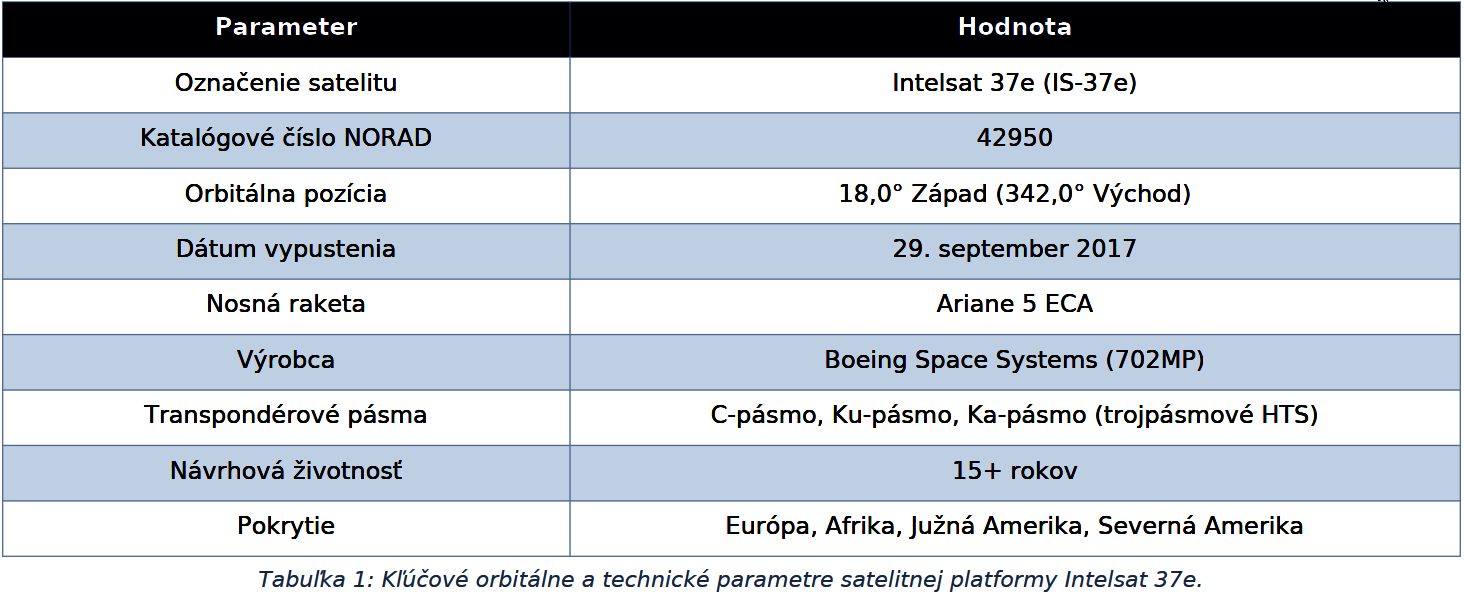
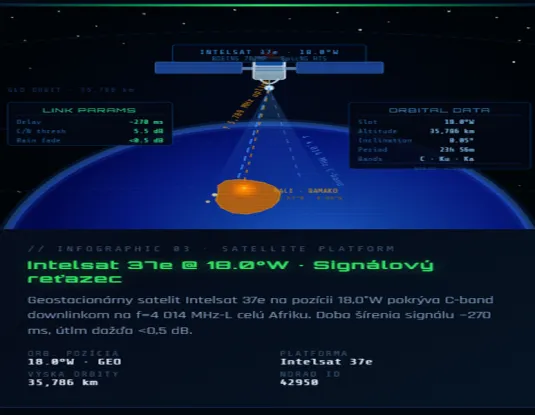
Intelsat 37e (IS-37e) je geostacionárny komunikačný satelit piatej generácie EpicNG (High Throughput Satellite, HTS) prevádzkovaný spoločnosťou Intelsat S.A. Spacecraft bol vyrobený spoločnosťou Boeing Space Systems (platforma Boeing 702MP) a vypustený raketou Ariane 5 ECA dňa 29. septembra 2017 z Guianskeho vesmírneho strediska, spoločne so satelitom BSAT-4a. Intelsat 37e zaujíma geostacionárnu orbitálnu pozíciu 18,0° Západ (ekvivalent 342,0° Východ). Satelit je vyrobený na báze trojpásmovej platformy Boeing 702MP (C, Ku, Ka pásmá) s návrhovým životom 15+ rokov.
2.2 Frekvenčné plánovanie C-pásma
C-pásmový downlink pre Fixed Satellite Service (FSS) v regióne 1 ITU pokrýva pásmo 3 400–4 200 MHz.
Signál ORTM je prenášaný na downlinkovej nosnej frekvencii 4 014 MHz. Označenie '_L' v databázach
satelitného monitorovania indikuje ľavotočivú polarizáciu downlinkového vlnenia. Pri LNB s typickým lokálnym oscilátorm (LO) = 5 150 MHz: f_IF = 5 150 − 4 014 = 1 136 MHz, čo zodpovedá štandardnému rozsahu satelitného prijímača 950–1 750 MHz.
2.3 Výhody C-pásma v tropickom a saharskom prostredí
Nadradenie C-pásma (3,7–4,2 GHz downlink) nad Ku-pásmom (10,7–12,75 GHz) pre satelitné príspevkové linky v subsaharskej Afrike je dobre etablované v odbornej literatúre. V C-pásme útlm signálu spôsobený dažďom typicky nepresahuje 0,5–1 dB pre geostacionárne satelitné linky na zemepisnej šírke Bamaka (presne
3. ROZHRANIE MODULÁTORA DVB-T2 (T2-MI): TECHNICKÁ ARCHITEKTÚRA
3.1 Príjem C-pásma: konverzia LNB a doručenie IF
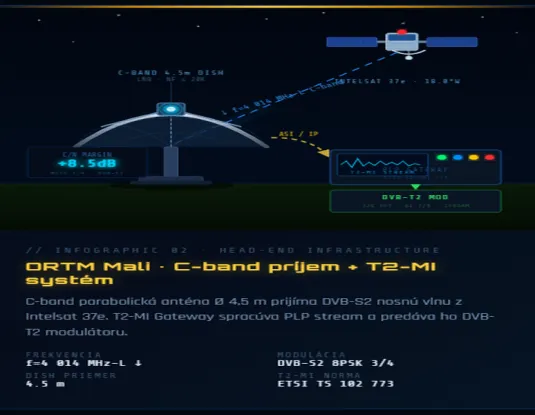
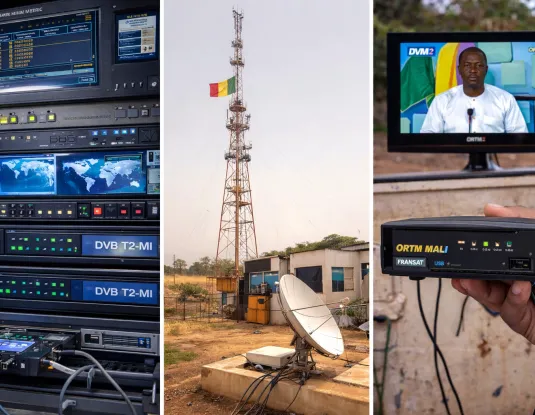
V profesionálnych head-end aplikáciách v Mali a Západnej Afrike sa používajú primárne parabolické antény s priemermi 4,5 m až 7,5 m. Tieto rozmery sú nevyhnutné kvôli nižšej hustote EIRP satelitov C-pásma a väčšej vlnovej dĺžke pri C-pásme (λ ≈ 7,5 cm pri 4 GHz). Nízkošumový blokový konvertor (LNB)montovaný na napájači parabolickej antény vykonáva dve kritické funkcie: nízkošumové zosilnenie prijatého C-pásmového signálu a frekvenčnú konverziu na medzifrekvencii (IF) v L-pásmovom rozsahu vhodnom na prenos cez štandardný 75-Ω koaxiálny kábel k demodulátoru/IRD (Integrated
Receiver-Decoder).
3.2 Modulačná vrstva DVB-S2
Nosná vlna na transpondéri Intelsat 37e na frekvencii 4 014 MHz (H) využíva štandard DVB-S2 (ETSI EN 302 307-1), ktorý používa kódovanie LDPC (Low-Density Parity-Check) zreťazené s BCH (Bose-Chaudhuri-Hocquenghem). Dostupné modulačné možnosti v DVB-S2 zahŕňajú QPSK (2 bity/symbol), 8PSK (3 bity/symbol), 16APSK (4 bity/symbol) a 32APSK (5 bitov/symbol). Pre príspevkové linky T2-MI v prostredí C-pásma v Západnej Afrike je preferovaná modulácia QPSK alebo 8PSK s kódovými rýchlosťami 3/4 alebo 2/3, čo predstavuje praktický kompromis medzi spektrálnou účinnosťou a dostupnosťou linky.
3.3 T2-MI: Štandard rozhrania modulátora DVB-T2
T2-MI (DVB-T2 Modulator Interface) je špecifikovaný v norme ETSI TS 102 773 a predstavuje kľúčovú technológiu umožňujúcu architektúru siete DVB-T2 vysielačov napájaných prostredníctvom satelitu, ktorú využíva ORTM. T2-MI definuje štandardizovaný protokol na prenos kompletnej sady informácií požadovaných modulátorom DVB-T2 — vrátane všetkých bázopásmových rámcov (BBFRAME), synchronizačných časových pečiatok a signalizačných parametrov vrstvy L1 (Layer 1) — od T2-brány (head-end enkodér/multiplexor) k jednému alebo viacerým distribuovaným modulátorom prostredníctvom akejkoľvek IP-schopnej alebo ASI transportnej cesty.
Fundamentálnou architektonickou inováciou T2-MI v kontexte geograficky distribuovaných vysielacích sietí je oddelenie funkcie spracovania a plánovania obsahu (vykonávanej na centrálnej T2-bráne v Bamako) od funkcie generovania RF signálu (vykonávanej na každom distribuovanom mieste DVB-T2 modulátora/vysielača). T2-brána zapúzdruje plne spracovaný DVB-T2 signál — vrátane PLP multiplexovania, LDPC/BCH FEC kódovania, bitového prekladania a mapovania buniek — do štandardizovaného T2-MI transportného toku. Tento T2-MI tok je následne transportovaný prostredníctvom satelitnej linky Intelsat 37e v C-pásme, prijímaný na každom mieste DVB-T2 vysielača a priamo privádzaný k lokálnemu DVB-T2 modulátoru, ktorý nevyžaduje žiadne ďalšie spracovanie nad rámec OFDM modulácie a RF prevádzania na vyššiu frekvenciu.
Z hľadiska sieťovej synchronizácie nesie T2-MI presné časovacie informácie umožňujúce prevádzku jednofrekvenčnej siete (SFN — Single-Frequency Network): viacero vysielačov vysielajúcich rovnaký DVB-T2 multiplex na rovnakom RF kanáli môže byť synchronizovaných v rámci ochranného intervalu DVB-T2 (typicky 1/8 alebo 1/32 periódy OFDM symbolu), čím sa predchádza vzájomnej interferencii medzi vysielačmi v oblastiach prekrývajúceho sa pokrytia. Táto schopnosť SFN je pre Mali nevyhnutná, kde jediný národný multiplex musí pokrývať osem regiónov z malého počtu vysokovýkonných vysielačov s potenciálne sa prekrývajúcimi oblasťami pokrytia v obývaných zónach.
4. ARCHITEKTÚRA FYZICKEJ VRSTVY RÚRA (PLP)
4.1 Koncept a zdôvodnenie PLP
Physical Layer Pipe (PLP) je základná logická kanálová štruktúra DVB-T2, ako je definovaná v ETSI EN 302 755 v1.4.1. PLP je nezávisle kódovaný a modulovaný logický bitový prúd v rámci signálu DVB-T2, ktorý prenáša jeden alebo viac transportných prúdov alebo iných dátových služieb. Architektúra PLP v kontexte ORTM/Mali plní niekoľko operačne kritických funkcií: špecifickú robustnosť pre každú službu, diferencované pridelenie kapacity, efektivitu spoločného PLP pre zdieľanie SI tabuliek a synchronizáciu SFN prostredníctvom T2-MI rámcovacích a časovacích informácií.
4.2 Typy PLP a štruktúra rámca DVB-T2
ETSI EN 302 755 definuje dva primárne typy PLP pre T2-Base profil: PLP typu 1 (jeden rez na T2-rámec): každý PLP zaberá presne jeden súvislý časový rez v každom T2-rámci — minimalizuje čas prepínania kanálov. PLP typu 2 (dva alebo viac podrezov na T2-rámec): obsah PLP je rozdelený na viacero podrezov, čím sa zvyšuje časová diverzita a robustnosť príjmu v mobilnom prostredí.
5. DVB-T2 DIGITÁLNE POZEMNÉ VYSIELANIE V MALI
5.1 Adopcia DVB-T2 ako národného štandardu DTT
Mali patrí medzi väčšinu afrických krajín, ktoré prijali DVB-T2 (ETSI EN 302 755) ako národný štandard DTT. Rozhodnutie adoptovať DVB-T2 namiesto prvogeneračného DVB-T odráža načasovanie digitálneho prechodu Mali (po roku 2010) a výrazne vyššiu spektrálnu účinnosť DVB-T2 (až o 50 % väčšia priepustnosť ako DVB-T v rovnakom frekvenčnom pásme pre rovnaké podmienky príjmu). Spoločnosť TNT SAT Africa získala povolenie na iniciovanie digitálneho prechodu v roku 2018. Ku začiatku roku 2026 nie je stanovený formálny dátum vypnutia analógového vysielania.
6. PRIJÍMACIE ZARIADENIA, TRH DEKODÉROV A NASADENIE DTT V MALI
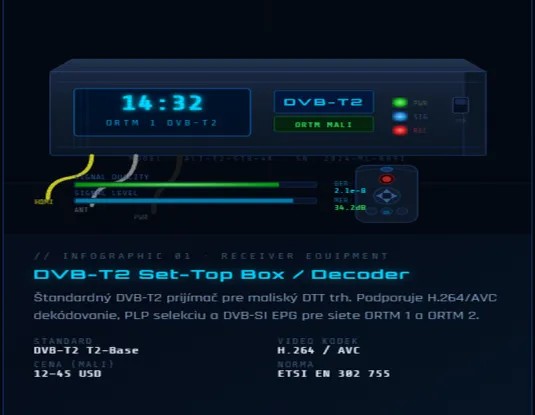
6.1 Technologické požiadavky na set-top boxy (STB)
Príjem pozemného signálu ORTM DVB-T2 vyžaduje vyhovujúci prijímač DVB-T2. Na maliskom trhu dominujú externé set-top boxy (STB/dekodéry) kvôli relatívne dlhej životnosti analógových televíznych prijímačov v domácnostiach s nižšími príjmami a cenovému rozdielu medzi vstupnými STB a novými integrovanými digitálnymi televízormi. Vyhovujúci STB DVB-T2 pre malický trh musí zahŕňať minimálne: DVB-T2 front-end tuner/demodulátor podporujúci profil T2-Base; LDPC/BCH dekodér; H.264/AVC video dekodér; MPEG-1 Layer II audio dekodér a štandardný SD AV výstup.
6.2 Ceny STB na maliskom trhu
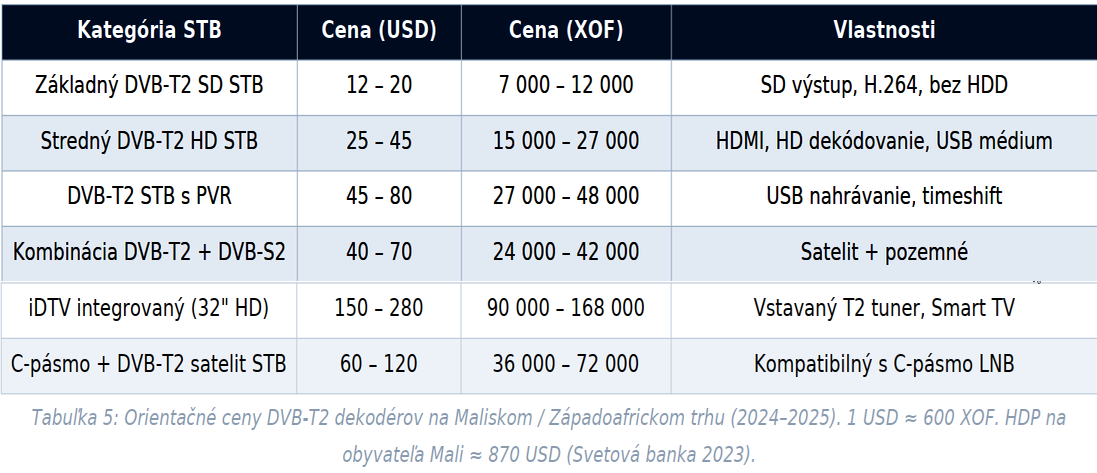
6.3 Odhady sledovanosti a počtu predplatiteľov
7. C-PÁSMOVÉ SATELITNÉ VYSIELANIE V AFRIKE
7.1 Výhody šírenia C-pásma v tropickom a saharskom prostredí
Pre zemepisnú šírku Bamaka (12,65°S) je ročná intenzita zrážok prekračovaná 0,01 % roku cca 70–90 mm/hod. Pri C-pásme (4 GHz) výsledný útlm trasy pre štandardný elevačný uhol k Intelsat 37e (presne 71,1° z Bamaka) dosahuje menej ako 0,5 dB v najhoršom ročnom štatistickom scenári. Pri Ku-pásme (12 GHz) by rovnaká udalosť zrážok produkovala útlm trasy presahujúci 8–12 dB. C-pásmové signály sú navyše úplne neovplyvnené suchosezónnou harmattanovou prachovou hmlou (november–marec).
8. KOMPLEXNÝ SIGNÁLOVÝ REŤAZEC: OD BAMAKA K PRIJÍMAČU
8.1 Head-end architektúra ORTM v Bamaku
Národné vysielacie centrum ORTM sa nachádza v Bamaku. T2-Brána v Bamaku prijíma komponentné TS prúdy, vykonáva priradenie PLP a konfiguráciu MODCOD, aplikuje FEC kódovanie LDPC/BCH, mapuje zakódované dáta na BBFRAMEs, generuje T2-MI časovacie a rámcovacie pakety a vydáva kompletný T2-MI TS vhodnou rýchlosťou pre šírku pásma satelitného uplinku. T2-MI TS je potom privádzaný na modulátor DVB-S2 uplinku, ktorý aplikuje vonkajší FEC DVB-S2 (LDPC/BCH) a 8PSK moduláciu, konvertuje na C-pásmo a napája zosilňovač vysokého výkonu (HPA) napájajúci vysielaciu anténu smerom k Intelsat-u 37e.
9. ZÁVER
Táto štúdia predstavila komplexnú technickú analýzu satelitného systému distribúcie vysielania ORTM Mali so špecifickým zameraním na architektúru T2-MI/PLP na nosnej vlne C-pásma Intelsat 37e na 4 014 MHz (L). Výber C-pásma je technicky optimálny pre malijské prostredie — útlm trasy menej ako 0,5 dB v najhoršom prípade oproti 8–12 dB pre Ku-pásmo. Architektúra T2-MI/PLP poskytuje nákladovo najefektívnejšie riešenie pre národné pokrytie DTT. ORTM si zachováva dominantný podiel publika 94,5 % pri správach. Systém je navrhnutý pre budúci prechod na HEVC a HbbTV bez architektonických zmien.
Zdrojovanie obsahu a referencie :
[1] ETSI EN 302 755 V1.4.1 (2015) – DVB-T2: Frame structure, channel coding and modulation.
[2] ETSI TS 102 773 V1.3.1 (2012) – DVB-T2 Modulator Interface (T2-MI).
[3] ETSI EN 302 307-1 V1.4.1 (2014) – DVB-S2 second generation framing structure.
[4] ITU-R Recommendation S.1779 (2007) – C-band FSS technical characteristics.
[5] ITU-R Recommendation P.838-3 (2005) – Specific attenuation model for rain.
[6] Intelsat S.A. (2020) – Intelsat 37e Fact Sheet. Luxembourg.
[7] Kantar / Africascope (2025) – Sub-Saharan Africa Media Study.
[8] Premise Data Corporation (2023) – News Sources in Mali: Media Consumption Preferences.
[9] World Bank Open Data (2024) – Mali: Population, GDP per capita, Urban Population.
[10] DVB Project / EBU (2023) – DTT Deployment Database. Geneva.
[11] ISO/IEC 13818-1:2022 – MPEG-2 Systems.
[12] ETSI EN 300 468 V1.16.1 (2019) – DVB Service Information (SI).
[13] State Media Monitor / MJRC (2025) – ORTM Global Dataset 2025. Zenodo.
[14] Afrobarometer (2024) – AD800 – Africa Shifting Media Landscapes.
ABSTRACT
This paper presents a comprehensive technical and socio-infrastructural analysis of the ORTM (Office de Radiodiffusion-Télévision du Mali) satellite broadcasting system, with specific focus on the T2-MI (DVB-T2 Modulator Interface) and PLP (Physical Layer Pipe) architecture employed for signal distribution via the Intelsat 37e geostationary satellite at orbital position 18.0° West. The ORTM signal is distributed in the C-band at a downlink frequency of 4,014 MHz (L-polarization,: exactly 1 136 MHz after LNB-LO conversion). The paper examines the technical rationale for adopting DVB-T2 as the national Digital Terrestrial Television (DTT) standard in Mali, the role of satellite-fed T2-MI streams in enabling Single-Frequency Network (SFN) and Multi-Frequency Network (MFN) terrestrial broadcast architectures across a landlocked nation of approximately 22.4 million inhabitants, the regulatory and economic landscape of decoder deployment, and the broader context of digital broadcasting in West Africa. The analysis is grounded in applicable ETSI/DVB standards and cross-referenced with verified operational data from satellite monitoring resources and primary broadcast engineering literature.
Keywords: DVB-T2, T2-MI, Physical Layer Pipe (PLP), Intelsat 37e, C-band satellite broadcasting, ORTM Mali, digital terrestrial television, SFN, Africa DTT, ETSI EN 302 755, ETSI TS 102 773
1. INTRODUCTION AND CONTEXTUAL FRAMEWORK
1.1 The Republic of Mali: Geography, Infrastructure and Broadcasting Challenges
The Republic of Mali (French: République du Mali) is a landlocked nation in West Africa covering an area of 1,241,238 km², making it the eighth-largest country on the African continent. With an estimated population of approximately 22.4 million (World Bank, 2024), Mali presents a demanding operational environment for national broadcast planners. Approximately 65% of the country's territory is classified as arid or semi-arid Saharan/Sahelian terrain, and the population is distributed across eight administrative regions and the capital district of Bamako, with significant rural dispersion and low population density in northern zones such as Kidal, Gao, and Timbuktu. The national electrical grid is unreliable and covers only approximately 30% of the territory, primarily concentrated in urban centres. Road infrastructure, while improving, remains insufficient to support the maintenance of large numbers of terrestrial transmitter sites in remote areas. These structural constraints make satellite-based signal contribution an operationally and economically superior solution for feeding a national network of Digital Terrestrial Television (DTT) transmitters, justifying the deployment of the T2-MI/PLP signal distribution architecture examined herein.
1.2 Historical Development of ORTM
Broadcasting in Mali predates national independence. Radio Soudan, a 1 kW AM transmitter operated from Bamako, commenced operations in 1957 under the French colonial administration of French Soudan. Following independence on 22 September 1960, the station was renamed Radio Nationale du Mali and subsequently expanded with the
assistance of Czech-supplied transmitters (18–30 kW, 1962) and four 50 kW Chinese-constructed transmitters positioned approximately 7 km from Bamako in the direction of Kati (commissioned 1970), which enabled Radio Mali to achieve coverage across much of West Africa. Television broadcasting was introduced on 22 September 1983 with the opening of a Libyan-financed broadcast centre in Bamako, enabling RTM (Radio-Télévision du Mali) to transmit one channel of colour television. The political transition of 1991–1992 brought liberalisation of the media sector: Law No. 92-021 of 5 October 1992 legalised private broadcasters and restructured RTM as ORTM (Office de Radiodiffusion-Télévision du Mali) from 1 January 1993. ORTM was further reorganised in 2015 through Ordinance No. 2015-036/PRM, which reaffirmed its public service mandate and separated its transmission infrastructure into a distinct entity. By 2002, ORTM operated 35 local radio and/or television broadcast points covering all eight administrative regions. ORTM operates as a public administrative institution (Établissement public à caractère administratif, EPA) with legal personality and financial autonomy. As of 2025, the organisation's Director General is Abdoulaye Traoré, appointed in early 2023. The broadcaster's 2024 operating budget was established at XOF 12.8 billion (approximately USD 22 million), of which XOF 6.94 billion (62%) was sourced from the national budget, reflecting growing dependence on state subsidisation due to declining commercial advertising revenues. ORTM maintains two television channels (ORTM 1 and ORTM 2), two national radio networks (Radio Mali / RTM and Chaine II), and coordinates the activities of regional broadcast points.
1.3 ORTM Audience Reach and Viewership
According to ORTM's own research and data published by the Premise survey platform (2023), ORTM is unambiguously the dominant television source for Malian audiences: 94.5% of survey respondents identified ORTM as their primary television news source, vastly ahead of commercial competitors Renouveau Télévision (68.9%), TM2 (51.2%), and Africable (46.7%). In the online domain, ORTM's website and streaming services were accessed by 72.9% of respondents. These figures confirm ORTM's position as the central national information infrastructure in Mali.
The Africascope 2025 study (Kantar, Sub-Saharan Africa edition covering eight francophone capital cities), which includes Bamako, reports that Mali records the lowest daily cumulative TV audience among the eight surveyed markets, at 63% of the measured population, with an average viewing time of 1 hour and 46 minutes per individual per day. This comparatively modest figure is largely attributable to Mali's structural characteristics: limited electricity access in rural zones, high costs of receiver equipment relative to average household income (GDP per capita ≈ USD 870, World Bank 2023), and the competing dominance of radio as a primary information medium (63% daily cumulative radio audience in Mali, Africascope 2025). It must be noted that the Africascope methodology covers only urban capital areas; rural penetration of television is structurally lower and represents a core argument for satellite-assisted DTT rollout.
2. 2. THE INTELSAT 37e SATELLITE PLATFORM
2.1 Satellite Specifications and Orbital Parameters
Intelsat 37e (also designated IS-37e) is a fifth-generation EpicNG (High Throughput Satellite, HTS) geostationary communications satellite operated by Intelsat S.A. The spacecraft was manufactured by Boeing Space Systems (Boeing 702MP platform) and launched by Ariane 5 ECA on 29 September 2017 from the Guiana Space Centre(Ariane Launch Area 3, Kourou, French Guiana), co-manifested with the Japanese BSAT-4a satellite. Intelsat 37e occupies the geostationary orbital slot at 18.0° West (equivalent to 342.0° East), replacing the legacy Intelsat 901 spacecraft in that position. Intelsat 37e is a flagship member of the EpicNG series, characterised by enhanced power-sharing technology that enables dynamic capacity allocation between shaped, fixed, and steerable spot beams in Ku-band and Ka-band. The satellite's C-band payload provides wide-area coverage across the African continent, the Atlantic Ocean basin, and parts of Europe and the Americas, making it an ideal distribution platform for pan-African broadcast services. The C-band African beam provides EIRP levels generally in the range of 34–40 dBW across Sub-Saharan Africa, with variations depending on specific beam geometry and transponder loading.
2.2 C-band Transponder Architecture and Frequency Planning
The C-band payload of Intelsat 37e conforms to the ITU-R frequency allocations for Region 1 (which encompasses EU and Africa). The downlink band for Fixed Satellite Service (FSS) C-band communications in Region 1 is 3.400–4.200 GHz, while the corresponding uplink (Earth-to-space) band is 5.725–6.425 GHz (commercial) and 5.850–7.075 GHz (extended).
Standard C-band FSS transponders on geostationary satellites are conventionally spaced 20 MHz apart in frequency,
with adjacent transponders operating on orthogonal polarisations (alternating horizontal and vertical linear polarisation,
or right-hand and left-hand circular polarisation) to provide frequency re-use. Each transponder nominally occupies approximately 36 MHz of usable bandwidth, with 4 MHz guard bands between same-polarisation transponders, yielding an effective centre-frequency separation of 40 MHz between co-polarised transponders. The ORTM signal is transmitted on the downlink carrier frequency of 4,014 MHz. The designation '_L' appended to thisfrequency in satellite monitoring databases ind icates the signal type is an L-band equivalent frequency — i.e., the frequency as it appears at the output of a standard C-band LNB (Low Noise Block downconverter), following the local oscillator conversion process described in Section 3.1. The RF downlink frequency of 4,014 MHz is consistent with transponder channel allocation within the standard C-band FSS downlink plan.
2.3 : Intelsat 37e Coverage and EIRP over West Africa
The C-band regional beam of Intelsat 37e provides hemispheric coverage including the entirety of West Africa. For Mali specifically — geographically positioned between latitudes 10°N and 25°N, and longitudes 4°W and 12°E, at an angular separation of approximately 22.0°–34.0° from the sub-satellite point on the surface — C-band EIRP values over the national territory are consistent with robust reception by professional-grade ground stations operating 4.5- to 7-metre parabolic antennas typically deployed at DTT transmission head-end facilities. Link budget analysis for such sites typically yields a margin of 6–10 dB above the DVB-S2 demodulation threshold for QPSK 3/4 at a symbol rate in
the range of 7–28 Msps, confirming reliable all-weather service. The superiority of C-band over Ku-band for Sub-Saharan African broadcast contribution is well-established in the engineering literature. At C-band frequencies, rainfall-induced attenuation in the tropical and equatorial rain zones of West Africa typically does not exceed 1–2 dB for path lengths relevant to geostationary satellite links at the Bamako latitude (12,6392°N). By contrast, Ku-band systems operating at 11–12 GHz may experience rain fade events exceeding 10–20 dB during intense convective rainfall cells, which are common in the Sahelian wet season (June–September). This fundamental propagation advantage renders C-band the preferred choice for mission-critical national broadcast contribution links in West Africa.
Harmattan is essentially a dry and dusty wind that blows across West Africa, usually from the end of November until mid-March. When we speak about the Harmattan dust haze, it refers to an accompanying phenomenon of this wind. The city of Bamako in Mali lies directly in the path of this wind. During the Harmattan season, this dust haze is usually at itsdensest in Bamako in the early morning and late morning hours. Everything — cars, houses and even the leaves of trees — becomes covered with a fine layer of reddish Saharan sand.
3. DVB-T2 MODULATOR INTERFACE (T2-MI): TECHNICAL ARCHITECTURE
3.1 C-band Reception: LNB Conversion and IF Delivery
The first stage of the ORTM signal reception chain at a terrestrial DTT transmitter head-end site is the C-band satellite
receiving antenna system. In professional broadcast head-end applications in Mali and West Africa, prime-focus parabolic dishes with diameters of 4.5 m to 7.5 m are deployed. These dimensions are necessitated by the lower EIRP density of C-band satellites relative to Ku-band high-power direct-broadcast satellites, and by the larger wavelength at C-band (λ ≈ 7.5 cm at 4 GHz vs. λ ≈ 2.5 cm at 12 GHz), which requires proportionally larger apertures to achieve comparable gain figures. The Low Noise Block downconverter (LNB) mounted at the feed of the C-band dish performs two critical functions:
low-noise amplification of the received C-band signal, and frequency downconversion to an intermediate frequency
(IF) in the L-band range suitable for transport via standard 75-Ω coaxial cable to the indoor demodulator/IRD (Integrated Receiver-Decoder). Professional-grade C-band LNBs for broadcast applications employ PLL(Phase-Locked Loop) oscillator circuits with frequency stability specifications of ±2–50 kHz, which is essential for reliable demodulation of multi-carrier DVB-S2 signals, particularly those employing high-order modulation (8PSK) combined with the T2-MI payload. For the ORTM carrier at 4,014 MHz, employing a standard Sub-Saharan African C-band LNB with a local oscillator (LO) frequency of 5,150 MHz, the resulting IF output frequency is computed as: f_IF = f_LO – f_RF = 5,150 – 4,014 = 1,136 MHz (for LO = 5,150 MHz)
3.2 DVB-S2 Satellite Modulation Layer
The transport carrier on the Intelsat 37e transponder at 4,014 MHz (H) employs the DVB-S2 standard (ETSI EN 302 307-1), which is the second-generation satellite transmission system optimised for broadcast and broadband applications. DVB-S2 employs LDPC (Low-Density Parity-Check) concatenated with BCH (Bose-Chaudhuri-Hocquenghem) outer coding, providing near-Shannon-limit performance characterised by the so-called 'waterfall' error-correction curve. The modulation options available in DVB-S2 range from QPSK (2 bits/symbol) through 8PSK (3 bits/symbol), 16APSK (4 bits-symbol), and 32APSK (5 bits/symbol), with corresponding increases in required C/N threshold. For T2-MI broadcast contribution links in the C-band environment typical of West Africa, QPSK or 8PSK modulation is preferred, providing the most robust link margin. The LDPC code rates available in DVB-S2 range from 1/4 to 9/10, with values of 3/4 and 2/3 commonly adopted for contribution quality broadcast links, representing a practical balance between spectral efficiency and link availability. At QPSK 3/4, the DVB-S2 demodulation threshold (quasi-error-free,QEF, defined as BER < 1000 at the MPEG-2 TS demultiplexer input) is approximately 5.5 dB Eb/N0, corresponding to approximately 7 dB C/N in a typical 36 MHz transponder bandwidth.
3.3 T2-MI: The DVB-T2 Modulator Interface Standard
The T2-MI (DVB-T2 Modulator Interface) is specified in ETSI TS 102 773 and is the key enabling technology for the sat-fed DTT transmitter network architecture employed by ORTM. T2-MI defines a standardised protocol for conveying the complete set of information required by a DVB-T2 modulator — including all baseband frames BBFRAMEs), synchronisation timestamps, and Layer 1 (L1) signalling parameters — from a T2-Gateway (head-end encoder/multiplexer) to one or more distributed modulators via any IP-capable or ASI transport path. The fundamental architectural innovation of T2-MI in the context of geographically distributed broadcast networks is the decoupling of the content processing and scheduling function (performed at the central T2-Gateway in Bamako) from the RF signal generation function (performed at each distributed DVB-T2 modulator/transmitter site). The T2-Gateway encapsulates the fully processed DVB-T2 signal — including PLP multiplexing, LDPC/BCH FEC encoding, bit interleaving, and cell mapping — into a standardised T2-MI Transport Stream. This T2-MI stream is then transported via the Intelsat 37e C-band satellite link, received at each DTT transmitter site, and directly fed to the local DVB-T2 modulator, which requires no additional processing beyond OFDM modulation and RF upconversion. From a network synchronisation perspective, T2-MI carries precise timing information that enables Single-Frequency Network (SFN) operation: multiple transmitters broadcasting the same DVB-T2 multiplex on the same RF channel can be synchronised to within the DVB-T2 guard interval (typically 1/8 or 1/32 of the OFDM symbol period), preventing inter-transmitter interference in regions of overlapping coverage. This SFN capability is essential for Mali, where a single national multiplex must cover eight regions from a small number of high-power transmitters with potentially overlapping coverage areas in populated zones.
3.4 T2-MI Protocol Structure
The T2-MI Transport Stream is based on the MPEG-2 TS (ISO/IEC 13818-1) packet structure of 188-byte fixed-length packets, identified by dedicated T2-MI PIDs (Packet Identifiers). The T2-MI protocol defines several packet types for carrying the various categories of information required by the modulator:
The T2-MI stream is encapsulated within the DVB-S2 satellite carrier as a standard MPEG-2 TS, transported as a single or multi-programme TS. At the receive end (each DTT transmitter site), a DVB-S2 IRD extracts the MPEG-2 TS from the satellite carrier and delivers it via ASI (Asynchronous Serial Interface, per EN 50083-9) or IP (Ethernet) to the local DVB-T2 modulator. The modulator parses the T2-MI stream, extracts the BBFRAMEs for each configured PLP, applies OFDM modulation (per ETSI EN 302 755), and outputs the DVB-T2 RF signal on the assigned UHF channel.
4. PHYSICAL LAYER PIPE (PLP) ARCHITECTURE IN THE ORTM T2-MI SIGNAL
4.1 PLP Concept and Rationale
The Physical Layer Pipe (PLP) is the fundamental logical channel structure of DVB-T2, as defined in ETSI EN 302 755
v 1.4.1. A PLP is an independently coded and modulated logical bitstream within a DVB-T2 signal, carrying one or more transport streams or other data services. The PLP concept supersedes the single-multiplex architecture of DVB-T (EN 300 744), enabling a paradigm shift from fixed-coding, fixed-modulation (FCFM) transmission to variable coding and modulation (VCM) or adaptive coding and modulation (ACM) architectures. In the ORTM/Mali context, the PLP architecture serves several operationally critical functions:
• Service-specific robustness: Mobile reception services can be assigned a more robust modulation/coding (e.g.,
QPSK 1/2) while HD fixed reception services use higher spectral efficiency (e.g., 256-QAM 4/5), all within the
same DVB-T2 multiplex.
• Differentiated capacity allocation: ORTM 1 (the main national channel) can be allocated a dedicated PLP with
guaranteed minimum bit rate, while supplementary services occupy variable-capacity PLPs.
• Common PLP efficiency: A single Common PLP can carry shared elements (SI tables: PAT, PMT, SDT, NIT,
EIT) for multiple data PLPs, reducing the overhead of replicating these tables across multiple PLPs.
• SFN synchronisation: Each PLP's T2-frame mapping is carried in T2-MI framing & timing information, enabling
all distributed transmitters to synchronise their PLP transmission schedules to sub-microsecond precision.
4.2 PLP Types and DVB-T2 Frame Structure
ETSI EN 302 755 defines two primary PLP types for the T2-Base profile (which is the profile relevant to the ORTM broadcast standard): Type 1 PLP (one slice per T2-frame): The simplest PLP type, where each PLP occupies exactly one contiguous time slice within each T2-frame. This type minimises receiver zapping time and is appropriate for high-priority,
high-reliability services. The receiver can enter power-saving mode between successive slices. Type 2 PLP (two or more sub-slices per T2-frame): The PLP payload is distributed across multiple sub-slices within each T2-frame, increasing time diversity and thus improving reception reliability in mobile or pedestrian environments. This type is preferred for services targeting mobile or portable reception scenarios. The DVB-T2 frame structure is hierarchical. The super-frame consists of one or more T2-frames. Each T2-frame begins with a P1 preamble symbol (the unique T2 signature, detectable in as little as one OFDM symbol duration) followed by one or more P2 pilot symbols (carrying L1 pre- and post-signalling). The data OFDM symbols follow, each carrying the time-sliced PLP data cells, Common PLP cells, and pilot patterns. The guard interval and FFT size govern the SFN capabilities and channel estimation performance:For the Malian DTT network, the selection of 32K FFT mode with a guard interval of 1/8 or 1/16 is technically optimal for nationwide coverage from a small number of high-power transmitters. The 32K mode provides the highest spectral efficiency within an 8 MHz channel (up to approximately 50.1 Mbit/s with 256-QAM, code rate 5/6, guard interval 1/128) and enables SFN operation with inter-transmitter distances exceeding 100 km, well-matched to the spacing of major population centres in Mali.
5. DVB-T2 DIGITAL TERRESTRIAL TELEVISION IN MALI
5.1 Adoption of DVB-T2 as the National DTT Standard
Mali is among the majority of African nations that have adopted DVB-T2 (the second-generation digital terrestrial TV standard, ETSI EN 302 755) as the national DTT standard, as documented in the DVB/EBU/BNE DTT Deployment Database (November 2023) and in the Wikipedia-sourced list of DVB-T2 adopters, which explicitly includes Mali alongside Algeria, Democratic Republic of the Congo, Ethiopia, Ghana, Kenya, Lesotho, Madagascar, Malawi, Mauritius, Mozambique, Namibia, Seychelles, Swaziland, Tanzania, Togo, Uganda, Zambia, and Zimbabwe. The decision to adopt DVB-T2 rather than the first-generation DVB-T (EN 300 744) standard reflects both the timing of Mali's digital transition (post-2010, by which time DVB-T2 was internationally standardised and receiving equipment was becoming commercially available at accessible price points) and the significantly superior spectral efficiency of DVB-T2 (up to 50% greater throughput than DVB-T in the same channel bandwidth for equivalent reception conditions). In a spectrum-constrained environment where a limited number of UHF channels must carry national and regional services across a vast territory, this efficiency advantage is operationally decisive. Mali's national regulator authorised TNTSAT Africa to initiate the digital transition in 2018. As of the latest available data (Wikipedia, Digital television transition, March 2026), no formal analog switch-off completion date has been established, indicating that the analog and digital platforms continue to coexist, a common transitional posture across West Africa where DTT equipment penetration in rural areas remains below the threshold required for a politically viable analog shutdown.
6. RECEIVER EQUIPMENT, DECODER MARKET AND DTT DEPLOYMENT IN MALI
6.1 Set-Top Box (STB) Technology Requirements
Reception of the ORTM DVB-T2 terrestrial signal requires a compliant DVB-T2 receiver, which may take one of three forms: (1) an external Set-Top Box (STB/decoder) connected to a legacy analogue television set via AV composite or SCART; (2) an integrated digital television (iDTV) set with a built-in DVB-T2 tuner; or (3) a hybrid STB incorporating both DVB-T2 and satellite (DVB-S2) reception capabilities. In the Malian market, external STBs dominate due to the comparatively long service life of analogue television sets in low-income households and the cost differential between entry-level STBs and new integrated digital televisions. A compliant DVB-T2 STB for the Mali market must as a minimum incorporate: a DVB-T2 front-end tuner/demodulator supporting the T2-Base profile (ETSI EN 302 755); LDPC/BCH decoder for all code rates defined in the standard; H.264/AVC video decoder; MPEG-1 Layer II audio decoder (and optionally HE-AAC or Dolby Digital Plus); DVB-SI processing for EPG display; and a standard-definition AV output (composite/SCART). HD-capable units additionally require an HDMI output and H.264 High Profile 4.1 decoding at up to 1920×1080i/p.
6.2 STB Pricing in the Malian Market
The cost of DVB-T2 decoders in the Malian and broader West African market is a critical barrier to digital transition completion. Based on market intelligence from regional electronics distributors operating in francophone West Africa (Côte d'Ivoire, Senegal, Mali), the following approximate price points are representative of the 2024–2025 period: The price sensitivity of the Malian STB market is acute. At a GDP per capita of approximately USD 870, an entry-level DVB-T2 STB priced at USD 15–20 represents approximately 2% of annual household income for the median Malian household, and a substantially higher proportion for rural households below the national median. This economic constraint is reflected in the ongoing coexistence of analog and digital platforms and the slow pace of analog switch-off. Policy interventions such as subsidised STB distribution programmes (analogous to those implemented in Tanzania, Rwanda, and Kenya) have been discussed in the Malian policy context but have not been formally implemented at scale as of early 2026.
6.3 Subscriber and Viewership Estimates
Precise, independently audited subscriber data for the Malian DTT platform is not publicly available, reflecting the
absence of a mandatory viewer registration system for the free-to-air DTT service. The following estimates are derived
from extrapolation of available demographic, household, and media consumption data:The preponderance of radio over television in Mali's media landscape (63% daily cumulative radio audience vs. 63% television audience in Bamako, with much lower rural TV penetration) is a structural feature that the DTT transition must ultimately address. The satellite-fed T2-MI architecture provides the technical foundation for a cost-effective national DTT network, but realisation of the full potential audience requires continued investment in affordable receiver equipment and electrical power infrastructure in rural areas.
7. C-BAND SATELLITE BROADCASTING IN AFRICA: TECHNICAL AND REGULATORY CONTEXT
7.1 Propagation Advantages of C-band in the Tropical and Saharan Environment
The selection of C-band (3.7–4.2 GHz downlink) for broadcast contribution links across Africa is grounded in fundamental electromagnetic propagation physics. The primary advantage of C-band over the higher-frequency Ku-band (10.7–12.75 GHz) and Ka-band (17.7–21.2 GHz) is its substantially reduced susceptibility to rain-induced signal attenuation, commonly quantified using the ITU-R Recommendation P.838-3 specific attenuation model for liquid precipitation. For the latitude of Bamako (12.63923°N), located at the boundary of the Sahelian and Sudanian climatic zones, the annual rainfall rate exceeded for 0.01% of the year (the standard link budget availability reference) is approximately 70–90 mm/hr. At C-band (4 GHz), the specific attenuation coefficient k·R^α at this rainfall rate yields a path attenuation (for a standard elevation angle to Intelsat 37e at 18°W of exactly 71.1° from Bamako) of less than 0.5 dB in the worst-case annual statistical scenario. At Ku-band (12 GHz), the identical rainfall event would produce path attenuation in excess of 8–12 dB, requiring a link margin that is economically prohibitive for rural and semi-urban head-end sites. Additionally, C-band signals are entirely unaffected by the dry season harmattan dust haze that characterises the November–March period in Mali (scattering at C-band wavelengths of ~7.5 cm from typical dust particles of 10–100 µm diameter is negligible), further reinforcing the operational availability advantage of C-band for the Malian broadcast context.
Professional C-band satellite reception for DTT head-end applications requires substantially larger parabolic antennas
than those used for Ku-band consumer direct-to-home (DTH) services. The theoretical antenna gain G (in dBi) for an
ideal parabolic reflector is given by: G = 10 × log(η × (π × D / λ)²), where η is the aperture efficiency (typically 0.55–0.65 for prime-focus designs), D is the dish diameter, and λ is the wavelength. At 4 GHz (λ = 0.075 m), a 4.5-metre dish achieves approximately 43.8 dBi gain (η = 0.6), while a 7-metre dish achieves approximately 47.4 dBi. C-band satellite operations in Africa are governed by the ITU Radio Regulations (RR), specifically the frequency allocations in the Radio Regulations Appendix 4 and the coordination procedures under Articles 9 and 11. Africa falls within ITU Radio Region 1, which assigns the 3,400–4,200 MHz downlink band to the Fixed Satellite Service (FSS) on. a primary basis, co-shared with the Fixed Service (FS) and, in certain sub-bands, the Mobile Service (MS). The shared spectrum with terrestrial microwave links (the primary historical use of C-band in Region 1) necessitates geographic coordination of earth station sites to avoid uplink interference to adjacent terrestrial microwave relay systems and downlink interference from terrestrial transmitters. The emerging 5G terrestrial mobile services represent a potential long-term pressure on the lower portion of the C-band downlink allocation (3.4–3.8 GHz), following the WRC-19 decisions and subsequent national frequency
planning in African ITU member states. However, the ORTM carrier at 4,014 MHz — well within the upper portion of the C-band FSS downlink allocation — is positioned in the spectral region least affected by 5G co-existence concerns,
providing robust regulatory protection for this national broadcast contribution service over the medium term.
8. END-TO-END BROADCAST SIGNAL CHAIN: FROM BAMAKO TO THE RECEIVER
8.1 ORTM Head-End Architecture in Bamako
The ORTM national broadcast centre is located in Bamako, the capital and largest city of Mali (population
approximately 2.5 million). As the origination point for all national television services, the Bamako head-end performs
the following primary functions in the DVB-T2/T2-MI signal chain: (1) Programme production and ingest: Live studio production, news capture, acquired content playout, and archive replay. Sources include studio-quality SDI (Serial Digital Interface, SMPTE 292M) feeds at 270 Mbit/s (SD) or 1.485 Gbit/s (HD). (2) Video compression: Encoding of source video material to H.264/AVC (MPEG-4 Part 10) at profile/level settings appropriate to the target bit rate and service type. For ORTM 1 (primary national channel), HD encoding at approximately 6–8 Mbit/s (CBR or light VBR); for ORTM 2 (secondary channel), SD encoding at approximately 2.5–4 Mbit/s. (3) MPEG-2 Transport Stream multiplexing: Assembly of video, audio, and data elementary streams into compliant MPEG-2 Transport Streams (TS), with insertion of DVB Service Information (SI) tables (NIT, PAT, PMT, SDT, EIT) per ETSI EN 300 468, and Conditional Access (CA) descriptors if applicable.(4) T2-Gateway processing: The T2-Gateway (a dedicated hardware appliance or software system from manufacturers such as ENENSYS Technologies, Harmonic, or Ericsson) receives the component TS streams,
performs PLP assignment and MODCOD configuration, applies LDPC/BCH FEC encoding per ETSI EN 302 755,
maps the encoded data to BBFRAMEs, generates T2-MI timing and framing packets, and outputs the complete T2-MI
TS at a rate appropriate for the satellite uplink bandwidth. (5) DVB-S2 uplink modulation: The T2-MI TS is fed to a DVB-S2 uplink modulator, which applies the outer DVB-S2 FEC (LDPC/BCH) and OFDM-equivalent QPSK/8PSK modulation, upconverts to C-band (uplink: 5.725–6.425 GHz, corresponding to a nominal uplink frequency of approximately 5,789 MHz for the 4,014 MHz downlink transponder), and drives the high-power amplifier (HPA, typically a Travelling-Wave Tube Amplifier (TWTA) of 100–400 W output power) feeding the transmit antenna.
8.2 Satellite Propagation and Transponder Chain
The uplinked C-band signal propagates to the Intelsat 37e transponder at 18.0°W. The satellite transponder receives the uplink signal, amplifies it with a Low-Noise Amplifier (satellite LNA), translates the frequency from the uplink band (5.925–6.425 GHz) to the downlink band (3.7–4.2 GHz) via an onboard frequency converter, and re-amplifies the translated signal with a Travelling-Wave Tube (TWT) or Solid-State Power Amplifier (SSPA) before radiation from the satellite downlink antenna. The one-way propagation delay from ground to satellite and back is approximately 270 ms (at the equator), introducing a fixed and predictable delay that is accounted for in the T2-MI SFN timing calculations.
8.3 DTT Transmitter Sites: Reception, Demodulation and RF Transmission
At each ORTM DTT transmitter site, the following equipment chain is deployed:
1 C-band parabolic antenna (4.5–7.5 m) Receive Intelsat 37e downlink at 4,014 MHz_L
2 C-band PLL LNB (NF ≤ 20 K) Amplify and downconvert to L-band (986–1,136 MHz)
8.4 Home Reception of DVB-T2 Signal
The DVB-T2 UHF signal radiated from each transmitter site is received by the viewer using a standard outdoor or indoor UHF broadband antenna (Yagi-Uda, log-periodic, or panel types are typical for fixed rooftop reception in Bamako and other Malian cities). The received signal is conveyed via 75-Ω coaxial cable (or antenna splitter for multi-room distribution) to the DVB-T2 STB or integrated TV. The STB performs: RF tuning and DVB-T2 OFDM demodulation; LDPC/BCH FEC decoding; PLP demultiplexing (selecting the desired PLP ID); MPEG-2 TS demultiplexing and service selection; H.264/AVC video decoding; audio decoding; and output to the display device.
9. STRATEGIC AND SOCIO-ECONOMIC DIMENSIONS OF BROADCAST DIGITISATION IN MALI
9.1 Digital Dividend and Spectrum Management
The transition from analogue terrestrial television to DVB-T2 DTT releases significant spectrum resources in the UHF band — the so-called 'digital dividend' — through the replacement of multiple analogue channels (each requiring a
separate 8 MHz allocation with geographic separation/guard band requirements imposed by the analogue adjacency
interference model) with a single DVB-T2 multiplex capable of carrying 6–15 services within one 8 MHz channel. In the
context of Mali's spectrum management challenges, the digital dividend frequencies (particularly the 700 MHz and 800
MHz sub-bands) can be redeployed for mobile broadband services, providing economic development benefits
extending beyond the broadcast sector.
9.2 Public Information Role and State Broadcasting Independence
ORTM fulfils a constitutionally mandated public information role in a country characterised by significant levels of functional illiteracy (approximately 35% adult literacy rate, World Bank) and rural community radio dependence.Television, while lagging behind radio in national reach, is the primary medium for visual information dissemination, ceremonial state communications, and electoral information in urban Mali. The 94.5% viewership share of ORTM for news content (Premise, 2023) underscores the broadcaster's structural dominance in the national information
ecosystem.However, press freedom assessments (Afrobarometer, 2024; State Media Monitor, 2025) indicate that ORTM's
editorial independence is constrained by government influence, with only 43% of Malians indicating support for a free media environment — the lowest figure among the 39 countries surveyed in the Afrobarometer Round 9. ORTM's 2024 budget structure (62% state-sourced funding) reinforces institutional dependency on government appropriations, a contextual factor relevant to understanding the political economy of the digital transition in Mali.
9.3 T2-MI as a Future-Proof Architecture
The deployment of T2-MI as the national broadcast contribution standard positions Mali's DTT network for future evolution without architectural disruption. T2-MI is agnostic to the specific content carried in each PLP: the addition of new services, the migration from H.264/AVC to H.265/HEVC video coding (offering equivalent quality at approximately
half the bit rate, enabling more services per multiplex or higher quality per service), or the introduction of DVB-T2 interactive/hybrid services (HbbTV — Hybrid Broadcast Broadband TV, ETSI TS 102 796) can all be accommodated within the existing T2-MI infrastructure by reconfiguring the T2-Gateway parameters and updating the PLP mapping,
without changes to the satellite uplink or the receiving head-end equipment at each transmitter site.
10. CONCLUSIONS
This case study has presented a comprehensive technical analysis of the ORTM Mali satellite broadcast distribution system, with specific focus on the T2-MI/PLP architecture employed on the Intelsat 37e C-band carrier at 4,014 MHz
(L polarisation). The following principal conclusions are drawn: 10.1 Technical Architecture: The ORTM signal chain implements a best-practice satellite-to-terrestrial broadcast contribution architecture: a central T2-Gateway in Bamako generates a T2-MI TS encapsulating all DVB-T2 PLP content; this T2-MI stream is uplinked via DVB-S2 to Intelsat 37e at 18.0°W; received at each DTT transmitter site via C-band dish and professional IRD; and fed directly to local DVB-T2 modulators for UHF terrestrial broadcast, enabling SFN operation across Mali's geographically dispersed transmitter network. 10.2 C-band Frequency Choice: The selection of C-band (4,014 MHz downlink) over Ku-band for the broadcast
contribution link is technically optimal for the Malian environment, providing superior rain-fade resilience (path attenuation < 0.5 dB vs. 8–12 dB for Ku-band in Sahelian storm conditions) and freedom from harmattan dust interference, ensuring broadcast continuity availability in excess of 99.9% annually. 10.3 PLP Architecture: The Physical Layer Pipe architecture of DVB-T2 enables service-specific coding and modulation within the ORTM national multiplex, allowing simultaneous delivery of HD services (ORTM 1), SD services (ORTM 2), audio-only services, and future data services within a single T2-MI stream and single UHF channel allocation, maximising spectral efficiency for national coverage. 10.4 Socio-economic Context: Mali's DTT transition faces structural challenges of STB affordability (entry-level decoders represent ~2% of median annual income), limited electricity access in rural areas, and a historically radio-dominant media consumption pattern. The satellite-fed T2-MI architecture provides the most cost-effective technical solution for national DTT coverage, pending the resolution of these socio-economic barriers. 10.5 Regulatory Status: As of early 2026, Mali's digital transition is ongoing with no formal analog switch-off date established, with DVB-T2 authorised since 2018 via TNTSAT Africa. The national broadcaster ORTM maintains dominant audience reach (94.5% news viewership share) and is technically positioned to serve as the anchor service of a future fully digital national broadcasting system.
11,REFERENCES AND STANDARDS
[1] ETSI EN 302 755 V1.4.1 (2015-02): Digital Video Broadcasting (DVB); Frame structure channel coding and modulation for a second generation digital terrestrial television broadcasting system (DVB-T2). European Telecommunications S tandards Institute, Sophia Antipolis.
[2] ETSI TS 102 773 V1.3.1 (2012): Digital Video Broadcasting (DVB); Modulator Interface (T2-MI) for a second generation digital terrestrial television broadcasting system (DVB-T2). ETSI, Sophia Antipolis.
[3] ETSI EN 302 307-1 V1.4.1 (2014): Digital Video Broadcasting (DVB); Second generation framing structure, channel coding and modulation systems for Broadcasting, Interactive Services, News Gathering and other broadband satellite applications (DVB-S2). ETSI.
[4] ETSI EN 300 744 V1.6.1 (2009): Digital Video Broadcasting (DVB); Framing structure, channel coding and modulation for digital terrestrial television (DVB-T). ETSI.
[5] ETSI EN 300 468 V1.16.1 (2019): Digital Video Broadcasting (DVB); Specification for Service Information (SI) in DVB systems. ETSI.
[6] ITU-R Recommendation S.1779 (2007): Technical and operational characteristics and protection criteria of fixed-satellite service systems in the 3 400–4 200 MHz frequency band. International Telecommunication Union.
[7] ITU-R Recommendation P.838-3 (2005): Specific attenuation model for rain for use in prediction methods. ITU Radiocommunication Sector.
[8] DVB Project (2012–2023): Implementation guidelines for a second generation digital terrestrial television broadcasting system (DVB-T2). DVB Document A133 Rev.2. DVB Project, Geneva.
[9] Intelsat S.A. (2020): Intelsat 37e Fact Sheet. Intelsat, Luxembourg.
[10] Wikipedia / Wikimedia Foundation (2026): Digital terrestrial television; Digital television transition; Office de Radiodiffusion-Télévision du Mali; C band (IEEE); DVB-T2. [Multiple articles accessed March 2026].
[11] Kantar / Africascope (2025): Africascope 2025 – Growth of the Internet, Stability of TV, Continued Decline of Radio. Kantar Insights, Paris.
[12] Premise Data Corporation (2023): News Sources in Mali: A Study on Media Consumption Preferences. Premise, San Francisco.
[13] State Media Monitor / Media and Journalism Research Center (2025): Office de Radio et Télévision du Mali (ORTM). State Media Monitor Global Dataset 2025. MJRC, Zenodo. https://doi.org/10.5281/zenodo.17219015
[14] Afrobarometer (2024): AD800 – Africa's Shifting Media Landscapes: Digital Media Use Grows, But So Do Demographic Divides. Afrobarometer Dispatch No. 800.
[15] ENENSYS Technologies (2023): DVB-T2 Technical Reference Guide. ENENSYS, Rennes.
[16] World Bank Open Data (2024): Mali Country Data – Population, GDP per capita,UrbanPopulation.data.worldbank.org.
[17] DVB Project / EBU / BNE (2023): DTT Deployment Database. DVB, Geneva.
[18] ISO/IEC 13818-1:2022: Information Technology – Generic Coding of Moving Pictures and Associated Audio Information: Systems
(MPEG-2 Systems). International Organization for Standardization.
ZUSAMMENFASSUNG
Diese Studie präsentiert eine umfassende technische und sozio-infrastrukturelle Analyse des Satelliten übertragungssystems ORTM (Office de Radiodiffusion-Télévision du Mali), mit spezifischem Schwerpunkt auf der T2-MI (DVB-T2 Modulator Interface)- und PLP (Physical Layer Pipe)-Architektur, die für die Signalverteilung über den geostationären Satelliten Intelsat 37e an der Orbitalposition 18,0° West verwendet wird. Das ORTM-Signal wird im C-Band auf der Downlink-Frequenz 4.014 MHz (L- Polarisation, L-Band: ca.1 136 MHz nach LNB-Konvertierung) verteilt. Die Studie untersucht die technischen Gründe für die Einführung von DVB-T2 als nationalen DTT-Standard in Mali, die Rolle satellitengespeister T2-MI-Streams bei der Ermöglichung von SFN- (Single-Frequency Network) und MFN- (Multi-Frequency
Network) Architekturen für terrestrische Übertragung in einem Binnenland mit ca. 22,4 Millionen Einwohnern, den Regulierungs- und Wirtschaftsrahmen der Dekoderbereitstellung sowie den breiteren Kontext der digitalen Rundfunkübertragung in Westafrika. Die Analyse basiert auf geltenden ETSI/DVB-Normen und ist mit verifizierten Betriebsdaten aus Satellitenüberwachungsquellen und primärer Rundfunktechnik-Literatur querverwiesen. : DVB-T2, T2-MI, Physical Layer Pipe (PLP), Intelsat 37e, C-Band-Satellitenrundfunk, ORTM Mali, digitales terrestrisches Fernsehen, SFN, Afrika DTT, ETSI EN 302 755, ETSI TS 102 773
1.EINLEITUNG UND KONTEXTUELLER RAHMEN
1.1 Republik Mali: Geographie, Infrastruktur und Übertragungsherausforderungen
Die Republik Mali ist ein Binnenstaat in Westafrika mit einer Fläche von 1.241.238 km², was sie zum achtgrößten Land des afrikanischen Kontinents macht. Mit einer geschätzten Bevölkerung von ca. 22,4 Millionen (Weltbank, 2024) stellt Mali eine anspruchsvolle Betriebsumgebung für nationale Rundfunkplaner dar. Etwa 65 % des Staatsgebiets sind als arides oder semiarides Sahara-/Sahelgebiet klassifiziert. Das nationale Stromnetz ist unzuverlässig und deckt nur etwa 30 % des Territoriums ab, hauptsächlich in städtischen Zentren. Diese strukturellen Einschränkungen machen die satellitengstützte Signalverteilung zur operationell und wirtschaftlich überlegenen Lösung für die Speisung eines nationalen DVB-T2-Sendernetzwerks.
1.2 Historische Entwicklung von ORTM
Radio Soudan, ein 1-kW-AM-Sender aus Bamako, nahm 1957 unter französischer Kolonialverwaltung den Betrieb auf. Nach der Unabhängigkeit am 22. September 1960 wurde er in Radio Nationale du Mali umbenannt und mit tschechischen Sendern (18–30 kW, 1962) und vier chinesischen 50-kW-Sendern (1970) ausgebaut. Der Fernsehbetrieb wurde am 22. September 1983 eingeführt. Gesetz Nr. 92-021 vom 5. Oktober 1992 liberalisierte den Mediensektor und restrukturierte RTM mit Wirkung vom 1. Januar 1993 zu ORTM. Das ORTM-Budget für 2024 wurde auf 12,8 Milliarden XOF (ca. 22 Millionen USD) festgesetzt, wovon 62 % aus dem Staatshaushalt stammen. ORTM betreibt zwei Fernsehkanäle (ORTM 1 und ORTM 2) sowie zwei nationale Radionetzwerke.
1.3 Einschaltquoten von ORTM
Laut der Premise-Umfrage (2023) ist ORTM für 94,5 % der Befragten in Mali die wichtigste Quelle fürFernsehnachrichten, weit vor kommerziellen Konkurrenten Renouveau Télévision (68,9 %), TM2 (51,2 %) und Africable (46,7 %). Die Africa-scope-Studie 2025 (Kantar) berichtet, dass Mali die niedrigste tägliche kumulative Fernsehhörerschaft unter den acht untersuchten afrikanischen Märkten aufweist — 63 % der gemessenen Bevölkerung mit einer durchschnittlichen Sehdauer von 1 Stunde und 46 Minuten pro Person und Tag.
2. DIE INTELSAT 37E SATELLITENPLATTFORM
2.1 Satellitenspezifikationen und Orbitalparameter
Intelsat 37e ist ein geostationärer Kommunikationssatellit der fünften Generation (EpicNG/HTS), der von Intelsat S.A. betrieben wird. Das Raumfahrzeug wurde von Boeing Space Systems (Boeing 702MP) gebaut und am 29. September 2017 mit Ariane 5 ECA vom Guiana Space Centre gestartet. Intelsat 37e besetzt die geostationäre Orbitalposition 18,0° West. Das ORTM-Signal wird auf der Downlink-Trägerfrequenz von 4.014 MHz (L) übertragen. Mit einem C-Band-LNB (LO = 5.150 MHz) ergibt sich eine ZF-Ausgangsfrequenz von 1 136 MHz.
2.2 C-Band-Frequenzplanung
Das C-Band-Downlink für den festen Satellitenfunkdienst (FSS) in der ITU-Region 1 umfasst den Bereich 3.400–4.200 MHz. Standard-C-Band-FSS-Transponder auf geostationären Satelliten haben einen Kanalabstand von 20 MHz, wobei benachbarte Transponder auf orthogonalen Polarisationen arbeiten. Das ORTM-Signal ist auf 4.014 MHz übertragen, was einem Standardkanal im C-Band-Downlink-Frequenzplan entspricht. Die Notation '4.014 MHz_L' in Satellitenmonitoring-Datenbanken bezeichnet die L-Band-Äquivalenzfrequenz nach LNB-Konvertierung.
3. DVB-T2 MODULATORSCHNITTSTELLE (T2-MI): TECHNISCHE ARCHITEKTUR
3.1 C-Band-Empfang: LNB-Konvertierung und ZF-Übertragung
Für professionelle Rundfunk-Headend-Anwendungen in Mali und Westafrika werden Parabolantennen mit Durchmessern von 4,5 m bis 7,5 m eingesetzt. Der Low Noise Block Downconverter (LNB) führt rauscharme Verstärkung und Frequenz-abwärtskonvertierung des C-Band-Signals in den L-Band-Zwischenfrequenzbereich (950–1.750 MHz) durch.
Was ist Harmattan? _ Der Harmattan ist im Wesentlichen ein trockener und staubiger Wind, der in Westafrika weht, gewöhnlich von Ende November bis Mitte März. Wenn wir von dem Harmattan-Staubdunst sprechen, handelt es sich um ein Begleitphänomen dieses Windes. Die Stadt Bamako in Mali liegt direkt auf dem Weg dieses Windes. Während der Harmattan-Saison ist dieser Staubdunst in Bamako am Morgen und am späten Vormittag gewöhnlich am dichtesten. Alles – Autos, Häuser und sogar die Blätter der Bäume – wird von einer feinen Schicht rötlichen Saharasandes bedeckt.
3.2 DVB-S2 Satellitenmodulationsschicht
Der Transportträger auf dem Intelsat 37e-Transponder verwendet den DVB-S2-Standard (ETSI EN 302 307-1) mit LDPC/BCH-Codierung. Für T2-MI-Rundfunkbeitragsverbindungen in der C-Band-Umgebung Westafrikas werden QPSK oder 8PSK mit Coderaten 3/4 oder 2/3 bevorzugt, was ein praktisches Gleichgewicht zwischen Spektraleffizienz und Verbindungsverfügbarkeit darstellt.
3.3 T2-MI: Der DVB-T2-Modulatorschnittstellenstandard
T2-MI ist in ETSI TS 102 773 spezifiziert. T2-MI definiert ein standardisiertes Protokoll zur Übertragung aller für einen DVB-T2-Modulator erforderlichen Informationen — einschließlich aller Basisbandrahmen (BBFRAMEs), Synchronisation-szeitstempel und L1-Signalisierungsparameter — von einem T2-Gateway zu einem oder mehreren verteilten Modulatoren über beliebige IP-fähige oder ASI-Transportpfade. Die fundamentale architektonische Innovation von T2-MI besteht in der Entkopplung der Inhaltsverarbeitungsfunktion (am zentralen T2-Gateway in Bamako) von der HF-Signal-erzeugungsfunktion (an jedem verteilten Modulator/Sender).
4. PHYSICAL LAYER PIPE (PLP)-ARCHITEKTUR
Physical Layer Pipe (PLP) ist die grundlegende logische Kanalstruktur von DVB-T2, definiert in ETSI EN 302 755 v1.4.1. Ein PLP ist ein unabhängig codierter und modulierter logischer Bitstrom innerhalb eines DVB-T2-Signals. Die PLP-Architektur ermöglicht dienstspezifische Robustheit, differenzierte Kapazitätszuweisung, Common-PLP-Effizienz und SFN Synchronisation via T2-MI Framing & Timing Information.
5. DVB-T2 DIGITALES TERRESTRISCHES FERNSEHEN IN MALI
Mali gehört zu den afrikanischen Ländern, die DVB-T2 (ETSI EN 302 755) als nationalen DTT-Standard übernommen haben. Die Wahl von DVB-T2 gegenüber DVB-T spiegelt das Timing des digitalen Übergangs Malis (nach 2010) und die deutlich höhere Spektraleffizienz von DVB-T2 (bis zu 50 % mehr Durchsatz) wider. Das Unternehmen TNTSAT Africa erhielt 2018 die Genehmigung zur Einleitung des digitalen Übergangs. Zu Beginn des Jahres 2026 ist kein formelles Datum für die Abschaltung der Analogübertragung festgelegt.
6. EMPFANGSGERÄTE, DEKODERMARKT UND DTT-EINSATZ IN MALI
Auf dem malischen Markt dominieren externe Set-Top-Boxen (STB). Einstiegs-DVB-T2-STBs sind für 12–20 USD (7.000–12.000 XOF) erhältlich. Geräte der mittleren Klasse mit HDMI kosten 25–45 USD. Angesichts eines Pro-Kopf-BIP von ca. 870 USD (Weltbank 2023) stellt selbst ein Einstiegs-STB etwa 2 % des jährlichen Medianeinkommens eines malischen Haushalts dar — eine erhebliche wirtschaftliche Hürde für die DTT-Durchdringung im Land.
7. SCHLUSSFOLGERUNGEN
Diese Studie hat eine umfassende technische Analyse des Satellitenrundfunk-Distributionssystems von ORTM Mali vorgestellt. Die Wahl des C-Bandes ist technisch optimal für die malische Umgebung (Pfaddämpfung < 0,5 dB gegenüber 8–12 dB für Ku-Band). Die T2-MI/PLP-Architektur bietet die kostengünstigste technische Lösung für die nationale DTT-Abdeckung. ORTM behält einen dominanten Zuschaueranteil von 94,5 % bei Nachrichten. Das System ist für die künftige Migration zu HEVC und HbbTV ohne architektonische Änderungen ausgelegt.
LITERATURVERZEICHNIS
[1] ETSI EN 302 755 V1.4.1 (2015) – DVB-T2: Frame structure, channel coding and modulation.
[2] ETSI TS 102 773 V1.3.1 (2012) – DVB-T2 Modulator Interface (T2-MI).
[3] ETSI EN 302 307-1 V1.4.1 (2014) – DVB-S2 second generation framing structure.
[4] ITU-R Recommendation S.1779 (2007) – C-band FSS technical characteristics.
[5] ITU-R Recommendation P.838-3 (2005) – Specific attenuation model for rain.
[6] Intelsat S.A. (2020) – Intelsat 37e Fact Sheet. Luxembourg.
[7] Kantar / Africascope (2025) – Sub-Saharan Africa Media Study.
[8] Premise Data Corporation (2023) – News Sources in Mali: Media Consumption Preferences.
[9] World Bank Open Data (2024) – Mali: Population, GDP per capita, Urban Population.
[10] DVB Project / EBU (2023) – DTT Deployment Database. Geneva.
[11] ISO/IEC 13818-1:2022 – MPEG-2 Systems.
[12] ETSI EN 300 468 V1.16.1 (2019) – DVB Service Information (SI).
[13] State Media Monitor / MJRC (2025) – ORTM Global Dataset 2025. Zenodo.
[14] Afrobarometer (2024) – AD800 – Africa Shifting Media Landscapes.
RÉSUMÉ
Cette étude présente une analyse technique et socio-infrastructurelle complète du système de radiodiffusion par satellite ORTM (Office de Radiodiffusion-Télévision du Mali), avec un accent particulier sur l'architecture T2-MI (Interface du Modulateur DVB-T2) et PLP (Physical Layer Pipe) utilisée pour la distribution du signal via le satellite géostationnaire Intelsat 37e à la position orbitale 18,0° Ouest. Le signal ORTM est distribué en bande C à la fréquence de liaison descendante de 4 014 MHz (polarisation L, bande L : environ 1 136 MHz après conversion LNB). L'étude examine les raisons techniques de l'adoption de DVB-T2 comme norme nationale de télévision numérique terrestre (TNT) au Mali, le rôle des flux T2-MI acheminés par satellite pour permettre les architectures SFN (Single-Frequency Network) et MFN (Multi-Frequency Network) de diffusion terrestre dans un pays enclavé d'environ 22,4 millions d'habitants, le paysage réglementaire et économique du déploiement des décodeurs, et le contexte plus large de la radiodiffusion numérique en Afrique de l'Ouest.
Mots-clés : DVB-T2, T2-MI, Physical Layer Pipe (PLP), Intelsat 37e, radiodiffusion satellite en bande C, ORTM Mali, télévision numérique terrestre, SFN, TNT Afrique, ETSI EN 302 755, ETSI TS 102 773
1. INTRODUCTION ET CADRE CONTEXTUEL
1.1 République du Mali : géographie, infrastructure et défis de radiodiffusion
La République du Mali est un pays enclavé d'Afrique de l'Ouest d'une superficie de 1 241 238 km², ce qui en fait le huitième plus grand pays du continent africain. Avec une population estimée à environ 22,4 millions d'habitants (Banque mondiale, 2024), le Mali représente un environnement opérationnel exigeant pour les planificateurs de la radiodiffusion nationale. Environ 65 % du territoire est classé comme zone aride ou semi-aride saharienne/sahélienne. Le réseau électrique national est peu fiable et ne couvre qu'environ 30 % du territoire, principalement dans les centres urbains.
1.2 Historique de l'ORTM
Radio Soudan, émetteur AM de 1 kW exploité depuis Bamako, a commencé à émettre en 1957. Après l'indépendance du 22 septembre 1960, il a été rebaptisé Radio Nationale du Mali et développé avec des émetteurs tchécoslovaques (18–30 kW, 1962) et quatre émetteurs chinois de 50 kW (1970). La télévision a été inaugurée le 22 septembre 1983 avec l'ouverture d'un centre de diffusion financé par la Libye. La loi n° 92-021 du 5 octobre 1992 a libéralisé le secteur médiatique et restructuré RTM en ORTM à compter du 1er janvier 1993. Le budget de l'ORTM pour 2024 s'est élevé à 12,8 milliards XOF (environ 22 millions USD), dont 62 % provenant du budget de l'État. L'ORTM exploite deux chaînes de télévision (ORTM 1 et ORTM 2) et deux réseaux radio nationaux.
1.3 Audience de l'ORTM
Selon l'enquête Premise (2023), l'ORTM est la principale source d'information télévisée pour 94,5 % des sondés au Mali, loin devant Renouveau Télévision (68,9 %), TM2 (51,2 %) et Africable (46,7 %). L'étude Africascope 2025 (Kantar) indique que le Mali enregistre la plus faible audience télévisuelle quotidienne cumulée parmi les huit marchés africains étudiés, soit 63 % de la population mesurée, avec une durée d'écoute moyenne de 1 heure et 46 minutes par personne et par jour.
2. LA PLATEFORME SATELLITAIRE INTELSAT 37E
Intelsat 37e est un satellite de communications géostationnaire de cinquième génération EpicNG (HTS), exploité par Intelsat S.A. Il a été lancé par Ariane 5 ECA le 29 septembre 2017 depuis le Centre Spatial Guyanais. Intelsat 37e occupe la position orbitale 18,0° Ouest. Le signal ORTM est transmis sur la fréquence porteuse descendante de 4 014 MHz (polarisation L). Avec un LNB bande C à oscillateur local de 5 150 MHz, la fréquence FI de sortie est de 1 136 MHz, ce qui correspond à la plage standard d'accord des récepteurs satellites.
Qu'est-ce que l'harmattan ? _ L’Harmattan est essentiellement un vent sec et poussiéreux qui souffle en Afrique de l’Ouest, généralement de la fin novembre jusqu’à la mi-mars. Lorsque l’on parle de la brume de poussière de l’Harmattan, il s’agit d’un phénomène accompagnant ce vent. La ville de Bamako, au Mali, se trouve directement sur la trajectoire de ce vent. Pendant la saison de l’Harmattan, cette brume de poussière est généralement la plus dense à Bamako tôt le matin et dans la matinée. Tout – voitures, maisons et même les feuilles des arbres – est recouvert d’une fine couche de sable saharien rougeâtre.
3. INTERFACE DU MODULATEUR DVB-T2 (T2-MI) : ARCHITECTURE
T2-MI (DVB-T2 Modulator Interface) est spécifié dans ETSI TS 102 773. T2-MI définit un protocole standardisé pour transmettre l'ensemble des informations nécessaires à un modulateur DVB-T2 — y compris toutes les trames en bande de base (BBFRAME), les horodatages de synchronisation et les paramètres de signalisation de couche L1 — d'une Passerelle T2 vers un ou plusieurs modulateurs distribués via tout chemin de transport IP ou ASI. Le porteur DVB-S2 utilise le codage LDPC/BCH (ETSI EN 302 307-1). Pour les liaisons de contribution T2-MI en bande C en Afrique de l'Ouest, la modulation QPSK ou 8PSK avec des taux de codage de 3/4 ou 2/3 est privilégiée.
4. ARCHITECTURE DU PHYSICAL LAYER PIPE (PLP)
Le Physical Layer Pipe (PLP) est la structure de canal logique fondamentale de DVB-T2, définie dans ETSI EN 302 755 v1.4.1. Un PLP est un flux binaire logique codé et modulé de manière indépendante au sein d'un signal DVB-T2. Dans le contexte ORTM/Mali, l'architecture PLP permet : une robustesse spécifique au service, une allocation de capacité différenciée, l'efficacité du PLP commun pour les tables SI partagées et la synchronisation SFN via les informations de cadrage et de synchronisation T2-MI.
5. TÉLÉVISION NUMÉRIQUE TERRESTRE DVB-T2 AU MALI
Le Mali fait partie de la majorité des pays africains ayant adopté DVB-T2 (ETSI EN 302 755) comme norme nationale TNT. Le choix de DVB-T2 plutôt que DVB-T reflète le calendrier de la transition numérique du Mali (après 2010) et l'efficacité spectrale nettement supérieure de DVB-T2 (jusqu'à 50 % de débit en plus). La société TNTSAT Africa a été autorisée à lancer la transition numérique en 2018. Au début 2026, aucune date formelle d'arrêt de l'analogique n'a été établie.
6. ÉQUIPEMENTS RÉCEPTEURS, MARCHÉ DES DÉCODEURS ET DÉPLOIEMENT TNT AU MALI
Sur le marché malien, les décodeurs DVB-T2 d'entrée de gamme sont disponibles pour 12 à 20 USD (7 000 à 12 000 XOF). Les appareils de gamme moyenne avec HDMI coûtent 25 à 45 USD (15 000 à 27 000 XOF). Compte tenu d'un PIB par habitant d'environ 870 USD, même un décodeur d'entrée de gamme représente environ 2 % du revenu annuel médian d'un ménage malien — une barrière économique significative à la pénétration de la TNT. L'audience estimée en télévision numérique terrestre est de 150 000 à 250 000 décodeurs déployés sur l'ensemble du territoire malien.
7. CONCLUSIONS
Cette étude a présenté une analyse technique complète du système de distribution de radiodiffusion parsatellite d'ORTM Mali, avec un accent particulier sur l'architecture T2-MI/PLP sur la porteuse C de l'Intelsat 37e à 4 014 MHz (L). Le choix de la bande C est techniquement optimal pour l'environnement malien (affaiblissement de trajet < 0,5 dB contre 8–12 dB pour la bande Ku). L'architecture T2-MI/PLP constitue la solution technique la plus rentable pour la couverture nationale TNT. L'ORTM maintient une part d'audience dominante de 94,5 % pour l'information. Le système est conçu pour la migration future vers HEVC et HbbTV sans modifications architecturales.
RÉFÉRENCES BIBLIOGRAPHIQUES
[1] ETSI EN 302 755 V1.4.1 (2015) – DVB-T2: Frame structure, channel coding and modulation.
[2] ETSI TS 102 773 V1.3.1 (2012) – DVB-T2 Modulator Interface (T2-MI).
[3] ETSI EN 302 307-1 V1.4.1 (2014) – DVB-S2 second generation framing structure.
[4] ITU-R Recommendation S.1779 (2007) – C-band FSS technical characteristics.
[5] ITU-R Recommendation P.838-3 (2005) – Specific attenuation model for rain.
[6] Intelsat S.A. (2020) – Intelsat 37e Fact Sheet. Luxembourg.
[7] Kantar / Africascope (2025) – Sub-Saharan Africa Media Study.
[8] Premise Data Corporation (2023) – News Sources in Mali: Media Consumption Preferences.
[9] World Bank Open Data (2024) – Mali: Population, GDP per capita, Urban Population.
[10] DVB Project / EBU (2023) – DTT Deployment Database. Geneva.
[11] ISO/IEC 13818-1:2022 – MPEG-2 Systems.
[12] ETSI EN 300 468 V1.16.1 (2019) – DVB Service Information (SI).
RESUMEN
Este estudio presenta un análisis técnico y socio-infraestructural exhaustivo del sistema de radiodifusión por satélite ORTM (Office de Radiodiffusion-Télévision du Mali), con especial énfasis en la arquitectura T2-MI (Interfaz del Modulador DVB-T2) y PLP (Physical Layer Pipe) empleada para la distribución de señales a través del satélite geoestacionario Intelsat 37e en la posición orbital 18,0° Oeste. La señal ORTM se distribuye en banda C a la frecuencia de enlace descendente de 4.014 MHz (polarización L, banda L: 1 136 MHz tras la conversión LNB). El estudio examina las razones técnicas para la adopción de DVB-T2 como estándar nacional de televisión digital terrestre (TDT) en Malí, el papel de los flujos T2-MI alimentados por satélite en la habilitación de arquitecturas SFN y MFN en un Estado sin acceso al mar de aproximadamente 22,4 millones de habitantes, el panorama regulatorio y económico del despliegue de descodificadores, y el contexto más amplio de la radiodifusión digital en África Occidental.
Palabras clave: DVB-T2, T2-MI, Physical Layer Pipe (PLP), Intelsat 37e, radiodifusión satelital en banda C, ORTM Mali, televisión digital terrestre, SFN, TDT África, ETSI EN 302 755, ETSI TS 102 773
1. INTRODUCCIÓN Y MARCO CONTEXTUAL
1.1 República de Malí: geografía, infraestructura y desafíos de radiodifusión
La República de Malí es un país sin acceso al mar en África Occidental con una superficie de 1.241.238 km², lo que la convierte en el octavo país más grande del continente africano. Con una población estimada de aproximadamente 22,4 millones de habitantes (Banco Mundial, 2024), Malí representa un entorno operativo exigente para los planificadores de la radiodifusión nacional. Aproximadamente el 65 % del territorio está clasificado como zona árida o semiárida sahariana/saheliana. La red eléctrica nacional es poco fiable y solo cubre el 30 % del territorio, principalmente en centros urbanos.
1.2 Historia de ORTM
Radio Soudan, un transmisor AM de 1 kW operado desde Bamako, comenzó sus emisiones en 1957 bajo la administración colonial francesa. Tras la independencia del 22 de septiembre de 1960, se rebautizó como Radio Nationale du Mali y se amplió con transmisores checoslovacos (18–30 kW, 1962) y cuatro transmisores chinos de 50 kW (1970). La televisión fue inaugurada el 22 de septiembre de 1983. La Leyn.° 92-021 del 5 de octubre de 1992 liberalizó el sector mediático y reestructuró RTM como ORTM desde el 1 de enero de 1993. El presupuesto de ORTM para 2024 fue de 12.800 millones de XOF (aprox. 22 millones USD), de los cuales el 62 % procedía del presupuesto estatal.
1.3 Audiencia de ORTM
Según la encuesta Premise (2023), ORTM es la principal fuente de noticias televisivas para el 94,5 % de los encuestados en Malí, muy por delante de Renouveau Télévision (68,9 %), TM2 (51,2 %) y Africable (46,7 %). El estudio Africascope 2025 (Kantar) indica que Malí registra la menor audiencia televisiva diaria acumulada de los ocho mercados africanos estudiados — un 63 % de la población medida, con un tiempo de visionado medio de 1 hora y 46 minutos por persona y día.
2. LA PLATAFORMA SATELITAL INTELSAT
Intelsat 37e es un satélite de comunicaciones geoestacionario de quinta generación EpicNG (HTS), operado por Intelsat S.A. Fue lanzado por Ariane 5 ECA el 29 de septiembre de 2017 desde el Centro Espacial de la Guayana. Intelsat 37e ocupa la posición orbital geoestacionaria a 18,0° Oeste. La señal de ORTM se transmite en la frecuencia portadora descendente de 4.014 MHz (L). Con un LNB de banda C con oscilador local de 5.150 MHz, la frecuencia FI de salida resultante es de 1 136 MHz, lo que corresponde al rango estándar de sintonización de los receptores de satélite (950–1.750 MHz).
¿Qué es el Harmattan? _ El Harmattan es esencialmente un viento seco y polvoriento que sopla en África Occidental, generalmente desde finales de noviembre hasta mediados de marzo. Cuando hablamos de la neblina de polvo del Harmattan, nos referimos a un fenómeno que acompaña a este viento. La ciudad de Bamako, en Mali, se encuentra directamente en la trayectoria de este viento. Durante la temporada del Harmattan, esta neblina de polvo suele ser más densa en Bamako por la mañana y durante las primeras horas del día. Todo —automóviles, casas e incluso las hojas de los árboles— queda cubierto por una fina capa de arena sahariana de color rojizo.
3. INTERFAZ DEL MODULADOR DVB-T2 (T2-MI): ARQUITECTURA TÉCNICA
T2-MI está especificado en ETSI TS 102 773. Define un protocolo estandarizado para transmitir toda la información requerida por un modulador DVB-T2 — incluyendo todos los fotogramas de banda base (BBFRAME), marcas de tiempo de sincronización y parámetros de señalización de capa L1 — desde una Pasarela T2 hacia uno o más moduladores distribuidos a través de cualquier ruta de transporte IP o ASI. El portador DVB-S2 emplea codificación LDPC/BCH (ETSI EN 302 307-1). Para los enlaces de contribución T2-MI en banda C en África Occidental, se prefiere la modulación QPSK u 8PSK con tasas de codificación de 3/4 o 2/3.
4. ARQUITECTURA DEL PHYSICAL LAYER PIPE (PLP)
El Physical Layer Pipe (PLP) es la estructura de canal lógico fundamental de DVB-T2, definida en ETSI EN 302 755 v1.4.1. Un PLP es un flujo de bits lógico codificado y modulado de forma independiente dentro de una señal DVB-T2. La arquitectura PLP en el contexto ORTM/Mali permite: robustez específica del servicio, asignación diferenciada de capacidad, eficiencia del PLP común y sincronización SFN mediante la información de temporización y encuadre T2-MI.
5. TELEVISIÓN DIGITAL TERRESTRE DVB-T2 EN MALÍ
Malí se encuentra entre los países africanos que han adoptado DVB-T2 (ETSI EN 302 755) como estándar nacional de TDT. La elección de DVB-T2 en lugar de DVB-T refleja el calendario de transición digital de Malí (posterior a 2010) y la significativamente mayor eficiencia espectral de DVB-T2 (hasta un 50 % más de caudal). La empresa TNTSAT Africa recibió autorización para iniciar la transición digital en 2018. A principios de 2026, no se ha establecido ninguna fecha formal de apagón analógico.
6. EQUIPOS RECEPTORES, MERCADO DE DESCODIFICADORES Y DESPLIEGUE DE TDT EN MALÍ
En el mercado maliense, los descodificadores DVB-T2 de gama básica están disponibles por 12–20 USD (7.000–12.000 XOF). Los de gama media con HDMI cuestan 25–45 USD (15.000–27.000 XOF). Dado un PIB per cápita de aproximadamente 870 USD, incluso un descodificador básico representa alrededor del 2 % de los ingresos anuales medianos de un hogar maliense — una barrera económica significativa para la penetración de la TDT. Se estima que hay entre 150.000 y 250.000 descodificadores TDT desplegados en todo el territorio de Malí.
7. CONCLUSIONES
Este estudio ha presentado un análisis técnico exhaustivo del sistema de distribución de radiodifusión satelital de ORTM Malí. La elección de la banda C es técnicamente óptima para el entorno maliense (atenuación de trayectoria < 0,5 dB frente a 8–12 dB para la banda Ku). La arquitectura T2-MI/PLP ofrece la solución técnica más rentable para la cobertura nacional de TDT. ORTM mantiene una cuota de audiencia dominante del 94,5 % para las noticias. El sistema está diseñado para la futura migración a HEVC y HbbTV sin cambios arquitectónicos.
8. REFERENCIAS BIBLIOGRÁFICAS
[1] ETSI EN 302 755 V1.4.1 (2015) – DVB-T2: Frame structure, channel coding and modulation.
[2] ETSI TS 102 773 V1.3.1 (2012) – DVB-T2 Modulator Interface (T2-MI).
[3] ETSI EN 302 307-1 V1.4.1 (2014) – DVB-S2 second generation framing structure.
[4] ITU-R Recommendation S.1779 (2007) – C-band FSS technical characteristics.
[5] ITU-R Recommendation P.838-3 (2005) – Specific attenuation model for rain.
[6] Intelsat S.A. (2020) – Intelsat 37e Fact Sheet. Luxembourg.
[7] Kantar / Africascope (2025) – Sub-Saharan Africa Media Study.
[8] Premise Data Corporation (2023) – News Sources in Mali: Media Consumption Preferences.
[9] World Bank Open Data (2024) – Mali: Population, GDP per capita, Urban Population.
[10] DVB Project / EBU (2023) – DTT Deployment Database. Geneva.
[11] ISO/IEC 13818-1:2022 – MPEG-2 Systems.
[12] ETSI EN 300 468 V1.16.1 (2019) – DVB Service Information (SI).
[13] State Media Monitor / MJRC (2025) – ORTM Global Dataset 2025. Zenodo.
[14] Afrobarometer (2024) – AD800 – Africa Shifting Media Landscapes.
АННОТАЦИЯ
Данное исследование представляет комплексный технический и социально-инфраструктурный анализ системы спутникового вещания ORTM (Office de Radiodiffusion-Télévision du Mali — Управление радиовещания и телевидения Мали) с особым акцентом на архитектуру T2-MI (интерфейс модулятора DVB-T2) и PLP (Physical Layer Pipe — канал физического уровня), применяемую для распределения сигнала через геостационарный спутник Intelsat 37e на орбитальной позиции 18,0° Западной долготы. Сигнал ORTM распределяется в C-диапазоне на частоте нисходящей линии 4 014 МГц (L поляризация). Исследование изучает технические обоснования принятия DVB-T2 в качестве национального стандарта цифрового наземного телевидения (ЦНТ) в Мали, роль спутниковых потоков T2-MI в обеспечении архитектур одночастотной сети (SFN) и многочастотной сети (MFN) в государстве с населением около 22,4 миллиона человек, регуляторный и экономический ландшафт развёртывания декодеров и более широкий контекст цифрового вещания в Западной Африке. Анализ основан на применимых стандартах ETSI/DVB и пере-крёстно подтверждён верифицированными оперативными данными.
Ключевые слова: DVB-T2, T2-MI, канал физического уровня (PLP), Intelsat 37e, спутниковое
вещание в C-диапазоне, ORTM Мали, цифровое наземное телевидение, SFN, ЦНТ Африка, ETSI
EN 302 755, ETSI TS 102 773
1. ВВЕДЕНИЕ И КОНТЕКСТУАЛЬНАЯ ОСНОВА
1.1 Республика Мали: география, инфраструктура и проблемы вещания
Республика Мали является государством без выхода к морю в Западной Африке с площадью 1 241
238 км², что делает её восьмой по величине страной африканского континента. С оценочным
населением около 22,4 миллиона человек (Всемирный банк, 2024 г.) Мали представляет собой
сложную операционную среду для национальных вещательных планировщиков. Приблизительно
65 % территории страны классифицируется как засушливые или полузасушливые
сахарские/сахельские территории. Национальная электросеть ненадёжна и охватывает лишь
около 30 % территории, преимущественно городские центры. Дорожная инфраструктура остаётся
недостаточной для обеспечения технического обслуживания большого числа наземных
передающих станций в отдалённых районах.
1.2 История ORTM
Радиовещание в Мали предшествует национальной независимости. Радиостанция «Радио Судан»
— AM-передатчик мощностью 1 кВт из Бамако — начала вещание в 1957 году. После обретения
независимости 22 сентября 1960 года она была переименована в «Радио Националь дю Мали» и
расширена с помощью чехословацких передатчиков (18–30 кВт, 1962 г.) и четырёх китайских
передатчиков мощностью 50 кВт (1970 г.). Телевизионное вещание было введено 22 сентября 1983
года. Закон № 92-021 от 5 октября 1992 года либерализовал медиасектор и реструктурировал RTM
в ORTM с 1 января 1993 года. Бюджет ORTM на 2024 год составил 12,8 млрд XOF (около 22 млн
долл. США), из которых 62 % поступают из государственного бюджета. ORTM эксплуатирует два
телевизионных канала (ORTM 1 и ORTM 2) и два национальных радиовещательных сети.
1.3 Аудитория ORTM
По данным опроса Premise (2023 г.), ORTM является основным источником телевизионных новостей
для 94,5 % респондентов в Мали — значительно опережая коммерческих конкурентов Renouveau
Télévision (68,9 %), TM2 (51,2 %) и Africable (46,7 %). Исследование Africascope 2025 (Kantar)
сообщает, что Мали фиксирует наименьшую ежедневную кумулятивную телевизионную
аудиторию среди восьми изученных африканских рынков — 63 % измеренного населения со
средним временем просмотра 1 час 46 минут в сутки на человека.
2. СПУТНИКОВАЯ ПЛАТФОРМА INTELSAT 37E
2.1 Характеристики спутника и орбитальные параметры
Intelsat 37e — геостационарный спутник связи пятого поколения EpicNG (высокопроизводительный спутник HTS), эксплуатируемый компанией Intelsat S.A. Космический аппарат был изготовлен компанией Boeing Space Systems (платформа Boeing 702MP) и запущен ракетой-носителем Ariane 5 ECA 29 сентября 2017 года с Гвианского космического центра. Intelsat 37e занимает геостационарную орбитальную позицию 18,0° Западной долготы. Сигнал ORTM передаётся на несущей частоте нисходящего канала 4 014 МГц (горизонтальная поляризация). При использовании LNB C-диапазона с гетеродином 5 000 МГц результирующая выходная частота ПЧ составляет 986 МГц, что соответствует стандартному диапазону настройки спутниковых приёмников (950–1 750 МГц)
2.2 Преимущества C-диапазона в тропической и сахарской среде
В C-диапазоне затухание сигнала, обусловленное дождём, как правило, не превышает 0,5–1 дБ для геостационарных спутниковых линий на географической широте Бамако (12,64° с. ш.) даже в наихудшем годовом статистическом сценарии. Для сравнения, системы Ku-диапазона могут испытывать замирания сигнала свыше 10–20 дБ во время интенсивных конвективных ливней, характерных для сахельского сезона дождей (июнь–сентябрь). Сигналы C-диапазона также полностью нечувствительны к сухосезонной пыльной мгле «харматтан» (ноябрь–март), что дополнительно повышает эксплуатационную доступность по сравнению с Ku-диапазоном.
3. ИНТЕРФЕЙС МОДУЛЯТОРА DVB-T2 (T2-MI): ТЕХНИЧЕСКАЯ АРХИТЕКТУРА
3.1 Приём C-диапазона: преобразование LNB и доставка ПЧ
Для профессиональных применений головного конца вещательного центра в Мали и Западной Африке исполь-зуются параболические антенны диаметром от 4,5 м до 7,5 м. Эти размеры обусловлены более низкой плотностью ЭИИМ спутников C-диапазона по сравнению с высокомощными спутниками непосредственного вещания Ku-диапазона и большей длиной волны в C-диапазоне (λ ≈ 7,5 см при 4 ГГц). Блочный малошумящий конвертер (LNB), установленный на облучателе параболической антенны, выполняет малошумящее усиление принятого сигнала
C-диапазона и частотное преобразование в полосу промежуточных частот (ПЧ) L-диапазона.
3.2 Спутниковый модуляционный уровень DVB-S2
Транспортный несущий сигнал на транспондере Intelsat 37e на частоте 4 014 МГц использует стандарт DVB-S2 (ETSI EN 302 307-1) с кодированием LDPC (контроль чётности с малой плотностью, LDPC) совместно с внешним кодом BCH (Боуза–Чоудхури–Хоккингема). Доступные варианты модуляции: QPSK (2 бит/символ), 8PSK (3 бит/символ), 16APSK (4 бит/символ) и 32APSK (5 бит/символ). Для линий вклада T2-MI в C-диапазоне в условиях Западной Африки предпочтительны QPSK или 8PSK со скоростями кодирования 3/4 или 2/3.
3.3 T2-MI: стандарт интерфейса модулятора DVB-T2
T2-MI (интерфейс модулятора DVB-T2) специфицирован в ETSI TS 102 773. T2-MI определяет стандарт-изированный протокол для передачи полного набора информации, необходимой модулятору DVB-T2, — включая все кадры базовой полосы (BBFRAME), метки времени синхронизации и параметры сигнализации уровня L1 — от T2-шлюза (головной кодирующий мультиплексор) к одному или нескольким распределённым модуля-торам через любой IP-совместимый или ASI транспортный путь. Фундаментальный архитектурный принцип T2-MI заключается в разделении функции обработки контента (выполняемой на центральном T2-шлюзе в Бамако) от функции генерации ВЧ-сигнала (выполняемой на каждом распределённом модуляторе/передатчике).
4. АРХИТЕКТУРА КАНАЛА ФИЗИЧЕСКОГО УРОВНЯ (PLP)
4.1 Концепция и обоснование PLP
Physical Layer Pipe (PLP) — это базовая логическая канальная структура DVB-T2, определённая в
ETSI EN 302 755 v1.4.1. PLP представляет собой независимо кодированный и модулированный
логический битовый поток в составе сигнала DVB-T2, несущий один или несколько транспортных
потоков или иных информационных служб. Архитектура PLP в контексте ORTM/Мали обеспечивает:
специфическую для каждой службы помехозащищённость, дифференцированное распределение
ёмкости, эффективность общего PLP для совместно используемых таблиц SI и синхронизацию SFN
через информацию кадрирования и синхронизации T2-MI.
4.2 Типы PLP и структура кадра DVB-T2
ETSI EN 302 755 определяет два основных типа PLP для профиля T2-Base: PLP типа 1 (один срез на
T2-кадр): каждый PLP занимает ровно один непрерывный временной срез в каждом T2-кадре, что
минимизирует время переключения каналов. PLP типа 2 (два или более подсреза на T2-кадр):
полезная нагрузка PLP распределена по нескольким подсрезам в каждом T2-кадре, что
увеличивает временное разнесение и повышает надёжность приёма в условиях мобильного или
пешеходного использования.
5. ЦИФРОВОЕ НАЗЕМНОЕ ТЕЛЕВИДЕНИЕ DVB-T2 В МАЛИ
5.1 Принятие DVB-T2 в качестве национального стандарта ЦНТ
Мали входит в большинство африканских государств, принявших DVB-T2 (ETSI EN 302 755) в
качестве национального стандарта ЦНТ. Решение об использовании DVB-T2 вместо DVB-T первого
поколения отражает сроки цифрового перехода Мали (после 2010 года) и существенно более
высокую спектральную эффективность DVB-T2 (до 50 % большая пропускная способность). В 2018
году компания TNTSAT Africa получила разрешение на начало цифрового перехода. По состоянию
на начало 2026 года официальная дата отключения аналогового вещания не установлена.
6. ПРИЁМНОЕ ОБОРУДОВАНИЕ, РЫНОК ДЕКОДЕРОВ И РАЗВЁРТЫВАНИЕ ЦНТ В МАЛИ
Приём наземного сигнала ORTM DVB-T2 требует совместимого приёмника DVB-T2. На малийском рынке доминируют внешние абонентские приставки (STB/декодеры) ввиду сравнительно длительного срока службы аналоговых телевизоров в малообеспеченных домохозяйствах. Совместимая приставка DVB-T2 для малийского рынка должна содержать как минимум: DVB-T2 тюнер/демодулятор переднего каскада (профиль T2-Base); LDPC/BCH-декодер; H.264/AVC видеодекодер; аудиодекодер MPEG-1 Layer II и стандартный SD AV выход.
6.1 Требования к абонентским приставкам (STB)
Приём наземного сигнала ORTM DVB-T2 требует совместимого приёмника DVB-T2. На малийском рынке доминируют внешние абонентские приставки (STB/декодеры) ввиду сравнительнодлительного срока службы аналоговых телевизоров в малообеспеченных домохозяйствах.Совместимая приставка DVB-T2 для малийского рынка должна содержать как минимум: DVB-T2тюнер/демодулятор переднего каскада (профиль T2-Base); LDPC/BCH-декодер; H.264/AVC видеодекодер; аудиодекодер MPEG-1 Layer II и стандартный SD AV выход.
6.2 Ценообразование на рынке STB в Мали
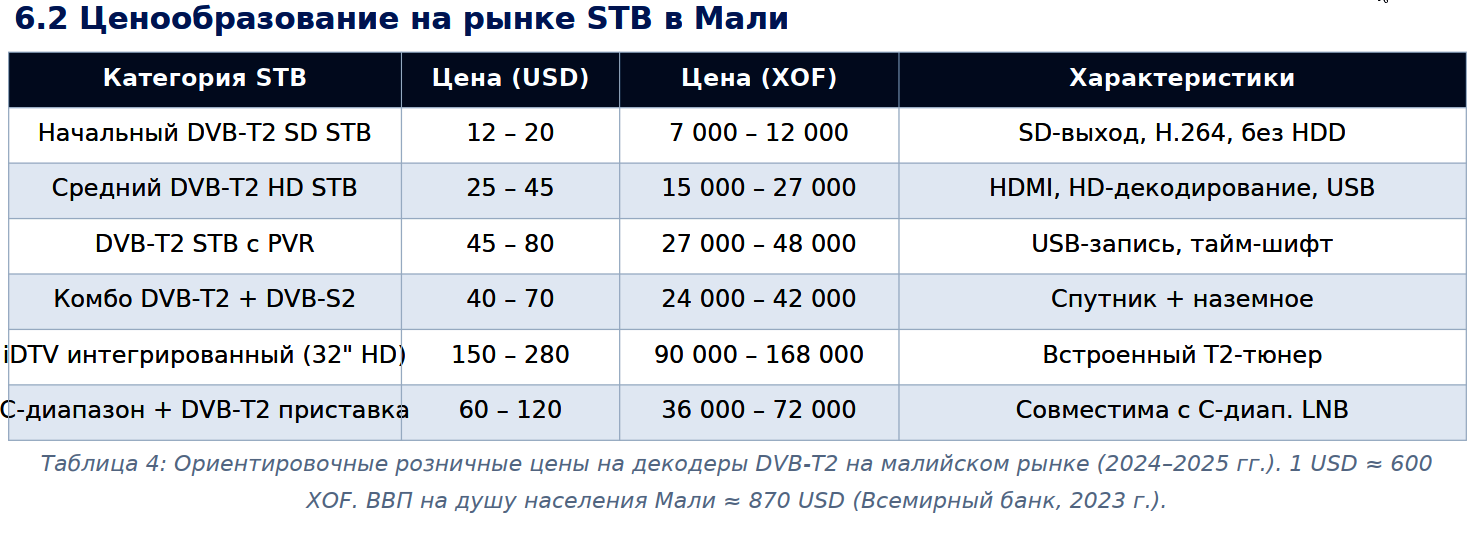
6.3 Оценки аудитории и числа абонентов
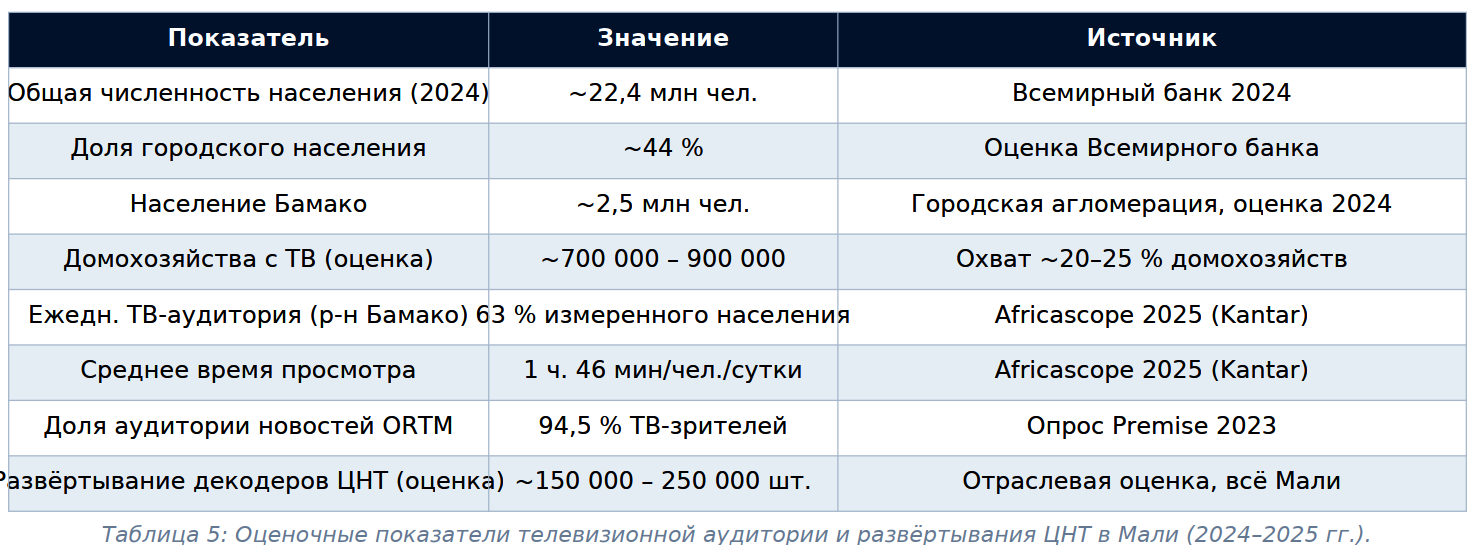
7. ЗАКЛЮЧЕНИЯ
Настоящее исследование представило комплексный технический анализ системы распределения спутникового вещания ORTM Мали с особым вниманием к архитектуре T2-MI/PLP на несущей C-диапазона Intelsat 37e на частоте 4 014 МГц (L-поляризация). Выбор C-диапазона является технически оптимальным: затухание трассы менее 0,5 дБ при наихудших погодных условиях против 8–12 дБ для Ku-диапазона. Архитектура T2-MI/PLP предлагает наиболее экономически эффективное техническое решение для национального покрытия ЦНТ. ORTM
сохраняет доминирующую долю аудитории 94,5 % в сегменте новостей. Система спроектирована для будущей миграции на HEVC и HbbTV без архитектурных изменений.
СПИСОК ИСПОЛЬЗОВАННОЙ ЛИТЕРАТУРЫ
[1] ETSI EN 302 755 V1.4.1 (2015) – DVB-T2: Frame structure, channel coding and modulation.
[2] ETSI TS 102 773 V1.3.1 (2012) – DVB-T2 Modulator Interface (T2-MI).
[3] ETSI EN 302 307-1 V1.4.1 (2014) – DVB-S2 second generation framing structure.
[4] ITU-R Recommendation S.1779 (2007) – C-band FSS technical characteristics.
[5] ITU-R Recommendation P.838-3 (2005) – Specific attenuation model for rain.
[6] Intelsat S.A. (2020) – Intelsat 37e Fact Sheet. Luxembourg.
[7] Kantar / Africascope (2025) – Sub-Saharan Africa Media Study.
[8] Premise Data Corporation (2023) – News Sources in Mali: Media Consumption Preferences.
[9] World Bank Open Data (2024) – Mali: Population, GDP per capita, Urban Population.
[10] DVB Project / EBU (2023) – DTT Deployment Database. Geneva.
[11] ISO/IEC 13818-1:2022 – MPEG-2 Systems.
[12] ETSI EN 300 468 V1.16.1 (2019) – DVB Service Information (SI).
[13] State Media Monitor / MJRC (2025) – ORTM Global Dataset 2025. Zenodo.
[14] Afrobarometer (2024) – AD800 – Africa Shifting Media Landscapes.